MF-109M - yet another VCA/EnvGen mockup

Building on the other ideas presented and a few of my own, here is the flow diagram I came up with (BIG thanks to Bryan B for creating the pretty mock-up and for helping with posting images!!):
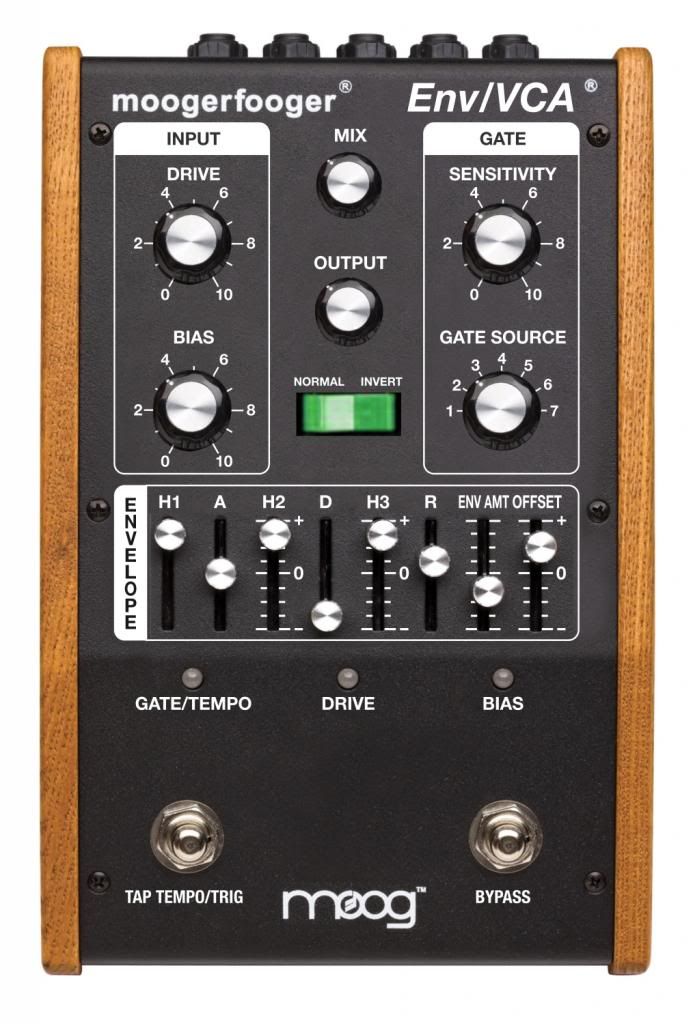
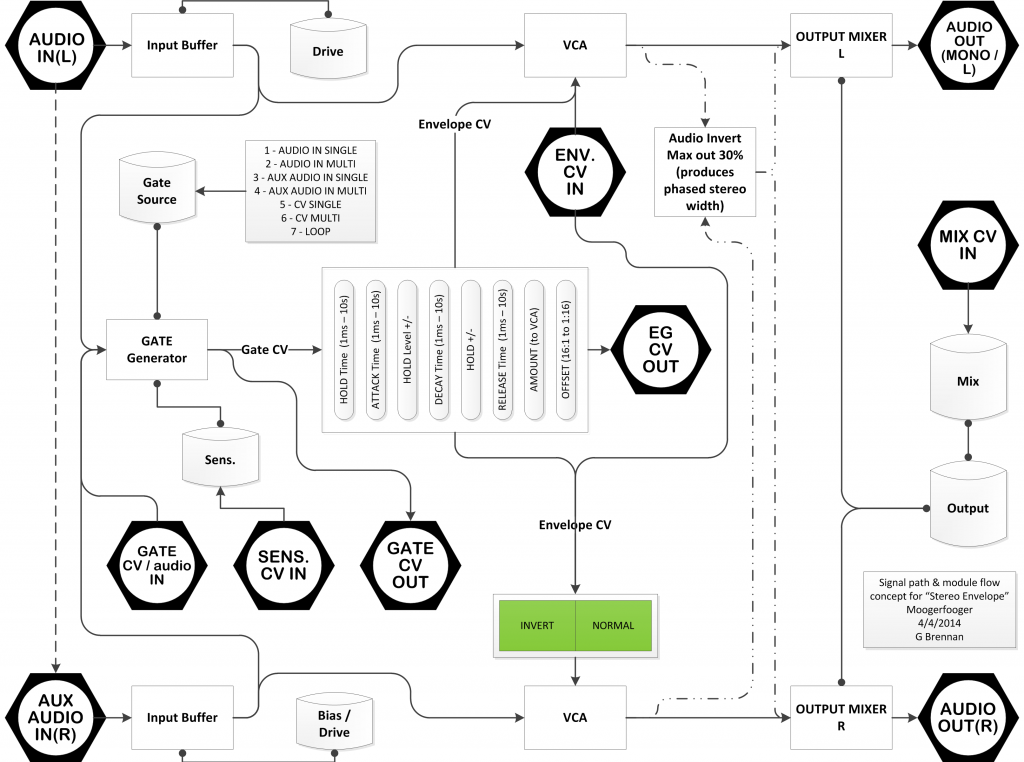
Written explanation:

6 knobs - Drive, Bias, Sensitivity, Gate Source, Mix, & Output.
8 sliders - Hold1, Attack, Hold2, Decay, Hold3, Release, Amount & Offset.
1 (green) rocker switch - Invert & Normal.

Bypass foot switch
Tap Tempo / Trigger foot switch

2 Audio inputs
2 Audio stereo outputs

Gate CV / Audio In
Envelope CV In

Sensitivity CV In
Mix CV In

Gate CV Out
Envelope Generator CV Out

MIDI input

LEDs for Drive, Bias, Gate Trigger / Tempo


AUDIO
Two Audio inputs “Audio (L)” & “AUX Audio (R)”. AUX is switched, when un-used “Audio (L)” is supplied here. One can input either a single audio source, or a stereo source, or two separate sources entirely. The input level of both channels can be adjusted at the Drive & Bias controls. The Audio signal is then sent to channel specific VCAs, a mixer and finally stereo output jacks. Mix controls the blend between the input signal and the effected signal. Output controls the overall level of the final sound.


VCA
The VCA can be controlled by an internal Envelope Generator or an externally supplied CV. A rocker switch is provided to “Invert” the control voltage for the right channel only. The result provides either panning / cross fading effects or volume envelope effects to both output channels. When only the mono output is used with two inputs the effect is an automated cross-fading mix. When one input and one output are used, the result is an additive tremolo effect that sounds similar to a Bias tremolo.


ENVELOPE GENERATOR
The Envelope Generator contains six stages: Hold1, Attack, Hold2, Decay, Hold3 and Release.

HOLD1 stage is time based. (1ms - 10s)

ATTACK is time based (1ms - 10s) and changes the voltage from 0v to the Hold2 voltage.

HOLD2 is peak based (+/-5V bi-polar voltage output) where the peak relates to the level of the VCA. In Invert mode with stereo outs, this controls the L / R stereo position, in Normal mode, this is the volume of the sources. Pressing and holding the TAP foot switch allows the user to set the length of time that the hold cycle is engaged for using the slider from 1ms to 10s.

DECAY is time based. (1ms - 10s) and changes the voltage from the Hold2 voltage to the Hold3 voltage.

HOLD3 is peak based (+/-5V bi-polar voltage output) where the peak relates to the level of the VCA. In Invert mode with stereo outs, this controls the L / R stereo position, in Normal mode, this is the volume of the sources. Pressing and holding the TAP foot switch allows the user to set the length of time that the hold cycle is engaged for using the slider from 0ms to infinite. At the maximum setting this hold stage acts as a sustain stage.

RELEASE is time based (1ms - 10s) and changes the voltage from the Hold3 voltage to 0v.

The envelope voltage is available at the CV out.


GATE / TRIGGER
The Envelope Generator is triggered by a Gate source. The source of the gate is selected using the Gate source knob, seven options are present. The unit contains an internal Gate generator that can be applied to either audio source, or the control voltage input - these sources have a sensitivity applied to them, meaning you can control when the gate is triggered by the source audio level. Each of these sources can trigger in two modes - Single, or Mulit. Single forces a full cycle of the EG based on Gate length. Multi allows a re-trigger to occur at any point in the cycle. Similar options are provided for the CV input, where the sensitivity can be applied to a third audio signal - the signal is not present at any output. The final source is a looping EG that is sync’d to the tap tempo, Gate CV pulse, or MIDI clock source. At any time, the Tap / Trigger foot switch can be used to trigger the gate, however it will behave corresponding to the Single / Mult. / Loop setting.


PATTERN
Two additional parameters - amount and offset have been set as sliders. Amount controls the amount of the envelope that is sent to the VCA. Offset is a bipolar control that can be used in conjunction with the Hold1. As offset is moved away from the centre position, the envelope sent to VCA2 is shifted by the amount specified. The limits are set as a ratio of the overall envelope. 1:1 produces an envelope that has all stages synchronized between VCAs. 1:16 would produce VCA1 envelope and 16 looped VCA2 envelopes. At the flip side, 16:1 would produce 16 VCA1 envelopes while one VCA2 is produced. The result is a rhythmical pattern in stereo, complex tremolos, or complex mixing of audio.


MIDI
Under the hood MIDI options would allow for adjustment of the stereo phase option. This would allow the user control of added width & balance within the unit, increasing the stereo field produced.

MIDI in would allow clock sync, and control of all parameters. This is where creativity can really be applied, as I had so many ideas for this part that it would take a while to type. Ultimately the architecture of the rest of the pedal would help define this. Things like syncing the EG stages to MIDI clock, as opposed to just the gate would be great.

CONCLUSION
I believe this idea should appeal to all users from DJs, synth lovers, guitar players and studio engineers. As usual, Moog sound quality to warm your tone!!

Hey Alien8, Ive been waiting curiously for your ideas, and I love them! What a great thing to see ideas evolve and become better. Ive been enjoying this collaborative thread a lot, and what a treat would it be to actually build such a thing collaboratively :sunglasses: .

What a clever way to implement panning, stereo and tremolo effects!
To make the Gate in jack also an “aux audio in” jack is a fantastic idea and should really please DJs and producers, even more so when you can have the resulting envelope both normal and inverted. The offset control is a great idea as well - you provide so many options in one single box!

Thats a great feature and adds a lot to the already huge flexibility. What Id like to see added though is some kind of “decaying looping envelope”. With a steady sound source like two Freqboxes it would be nice to have more options than “only” single or looping envelope. Maybe you could use the “unused” half of the knob range for that?

I totally agree with that! The only fear I have is that such a device would not be cheap… And the only sad thing is that with stereo ins and outs you sacrifice other CV options. But I guess I`d be more than happy to do so, looking at the possibilities.

Now, who`s going to build the prototype? :sunglasses: :mrgreen:

Cheers, radioland

Thanks for the kind words. The idea came through me.

I’m really hoping Moog at least tries their iteration of this idea, and I would love to hear it. After all, they have some form of a design for each section of this pedal in all of their other designs.

I wouldn’t expect this to be “cheap” either. Not much in the fooger line is cheap, but we don’t want cheap, we want diversity & control with little waste. This would probably run near to the price of a MIDI MuRF if not a little cheaper, maybe as low as $400…

…been playing with the kids outside… :sunglasses:


Yeah, I hope so too! Now that we know what they have been doing for the last three years (and they still managed to make the Sub Phatty and the Sub 37!), now they should have enough free manpower and time for such a comparatively tiny device…

That`s true. If we wanted just an Envgen and and Amplifier we could get that for under 300 anywhere. And I firmly believe that the writers in this thread would not be the only ones ready to pay the price for this missing Moogerfooger.

Cheers, radioland

I don’t see Moog releasing a Moogerfooger that isn’t also a stand alone effect by itself. This would be amazing for synth and multi-fooger owners, but don’t see much appeal to somebody looking for a single effect.

I think if you added a fuzz circuit and could allow for crazy gated fuzz sounds, or added an octaver that could be controlled by the envelope, you’d be in business. Since the Freqbox can already get some fuzz like tones (sort of), there’s more room in the lineup for an octaver. Like the Microsynth, but instead of an envelope controlling the filter, have the envelope simply control the volume of the octaves (with a master mix/blend for the envelope amount on the octaves). Since analog octavers are all pretty cranky, they usually have a type of envelope control built in to them to let them fade in and out naturally.

So, my vote would be to simplify the envelope controls and to add -2, -1, direct, and +1 octave controls to the pedal. This would still give you all the envelope options you’d need with a cp-251, and add an effect that would be in demand by synth, guitar and bass players along with a valuable studio effect. Add an MF-101 to the mix that is controlled by the envelope and it would be awesome.

I agree that Moog will only release an Env/Gate pedal if they think it will be of interest to enough people. And I guess that`s what has been the goal in this thread: To suggest features that would make this pedal a must have. So go on with that!
By now I think it could stand as an effect of its own (envelope-based amplitude-modulation, gating, panning) - and the Moog way of making a new pedal is being bold, giving extra options, sometimes fulfilling desires before customers have them…

This, on the other hand, sounds really tempting, too! Maybe you`d have to give customers something more to directly control with the envelope than “just” the amplitude.

Cheers, and have a good start into a new week of music making,

radioland

Pitch shifting is over done in my opinion. I mean it sounds neat for a bit, and has its few uses, but it’s already done well. HOG, POG, MicroSynth, Boss OC-2, Whammy 1,2 & 5, Bass Whammy, SuperEgo, MXR bass octave, PitchFactor, Rainbow Machine etc. there are so many of them now. I wouldn’t buy a Moog octave effect, I already have two awesome ones - even if they had a fully shapeable EG inside. No offense, just my opinion.

Even this “tremolo” idea seems a bit far fetched - (yay another tremolo!) but, this pedal could be so much more than that - especially in a stereo / parallel effect route chain. There’s nothing else like it, except for maybe a Boss Slicer combined with a pair of Pigtronix Philosopher Kings. Volume as a musical tool is one of the most underrated effects, if not THE. I really feel it is something that is missing from most playable sound rigs, unless you take your DAW with you.

If applied well, this pedal could do 3D imaging, phase & bias style trems & pans, sound transitions & blends, venture into ringmod & frequency modulation territory - and sync to MIDI. I would much prefer this over an octave “one trick pony”, but I’m just one dude, and already have my fill of octave solutions.

I wasn’t referring to another digital octaver. Digital sounds amazing for organ and 12 string sounds, but doesn’t do it for me on the synth or dirty/fuzz side. Analog is rarely perfected, IMO. Think of an octaver with the tracking and capability of the TWA Great Divide along with a Moog envelope generator. The pedal would absolutely kill and be up there with the analog delay for one of the best on the market.

And you could still accomplish many of listed effects for an env/gate pedal by turning the octaves down.

EDIT: I hope it doesn’t seem like I’m trying to crap on anybodies idea. I would actually love this. I have a stereo rig and am in need of a gate/envelope generator. It’s just that I think the best way to grab Moog’s attention on this is to follow the Moogerfooger formula that is set in motion. Classic effect with Moog’s synth controls and capabilities built in.

I certainly don’t feel poo-poo-d. Idea generating is about going deeper, and your explanation has.

Iron Ether Subterranea is another to compare to the TWA. Not as tweak-able, but very similar.

Both are a good idea really. The main difference being what appeals to the market - mono synth with EG VCA vs mono/stereo volume/mix processing. That’s to say if we could only have one :wink: - WHY NOT BOTH!

Yes, keep ideas, suggestions and adjustments coming - nobody owns this thread.

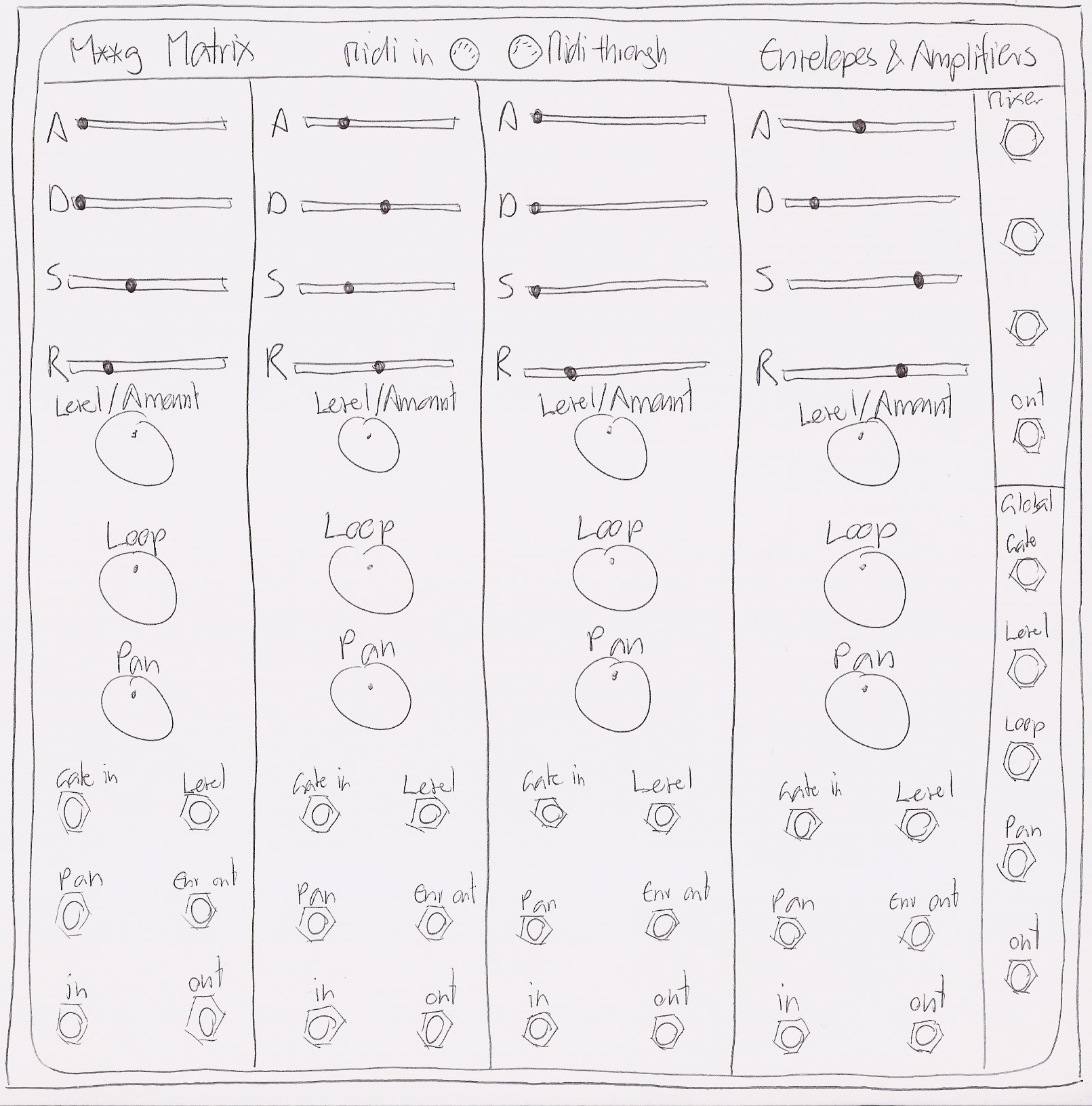
In the general topics (http://forum.moogmusic.com/viewtopic.php?f=1&t=21616) I suggested a new series of units as wide as a cp-251 and as long as a moogerfooger. Each unit offers 4x the same. This way you could build your own semi-modular polyphonic moog :smiley: .

This is what the envelopes/amplifiers unit looks like:

“The fourth and last box offers 4 individual envelopes and VCAs. The envelopes can loop (the loop knob controlling number of slowly decaying repeats) and the four outputs can be panned and appear as a stereo sound at the global output jack. Again you can control one or more parameters globally via the global jacks.
Use this as your last piece in the 4-voice polyphonic synthesizer, use it as the long awaited env/vca for your Foogertron or explore the interesting multi-stage-LFO you get with the envelope out!”

Maybe some sort of polyphony could be the “deal maker” for the missing moogerfooger?

Cheers, radioland

This week I have been sick for some days, and what do you do when it starts getting boring? Exatly, you think about your Moogerfooger idea again…

Maybe gates, envelopes, a VCA and panning are a bit too much for one Moogerfooger. And if you finally had such a thing, what would you control your Moogertron with? The Freqbox is no Midi-Fooger, and something like a Polyclavier from COTK is a bit pricey for the job…

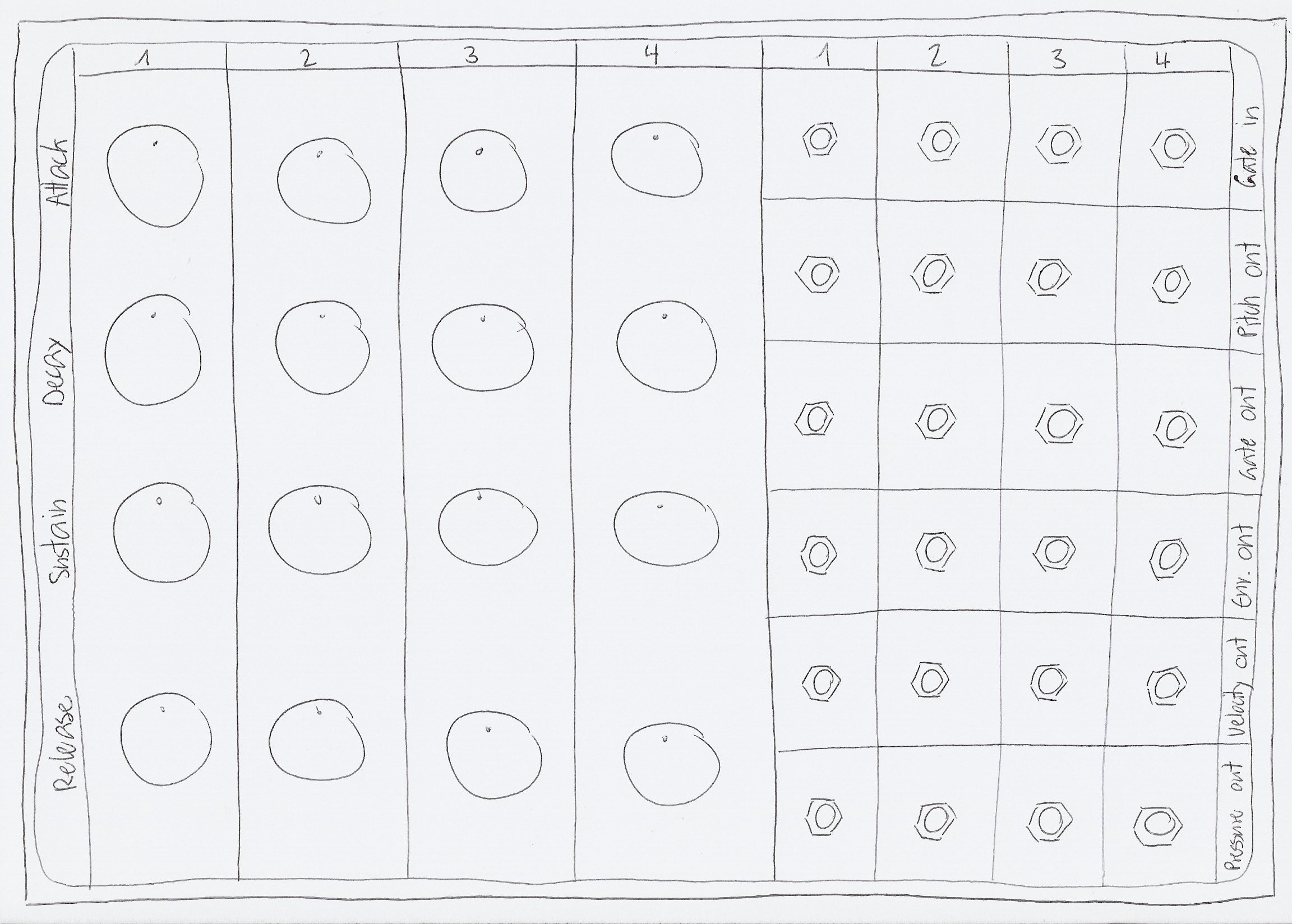
So, first idea: A Midi-to-CV Keyboard-Breakout-Box (that sure exists already, but anyway).

This cp-size box offers 4-voice polyphony. You connect it via Midi and you get individual pitch and gate outs as well as envelope, velocity and pressure outs. I included gate in jacks so you could trigger envelopes independent from a keyboard. With four individual ADSR controls you can give your four voices different “shapes”, a bit like on Vermonas PerFourmer. Maybe this box needs things like repeating envelopes or fine tune controls, but there`s not much space left.

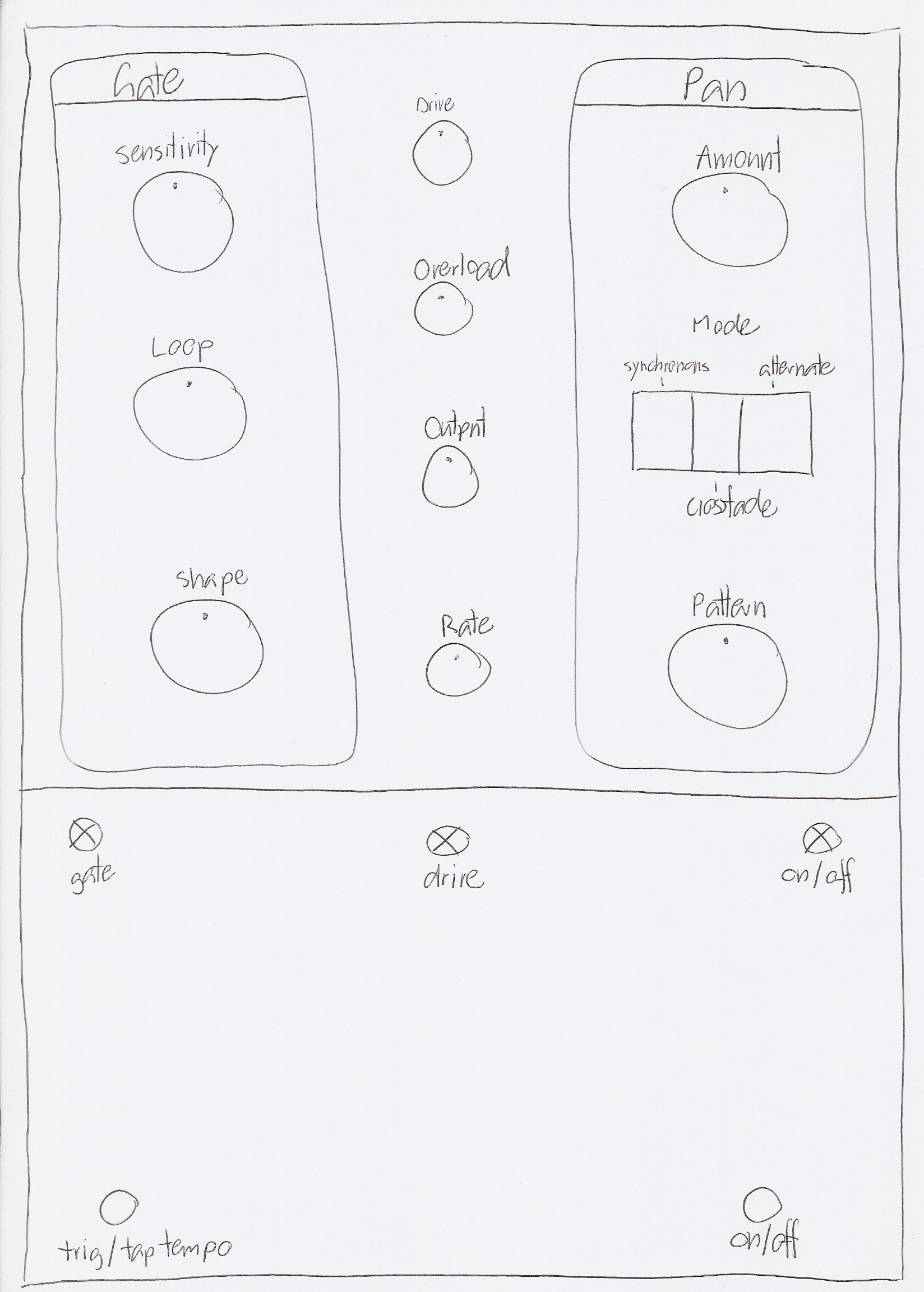
With the envelope section outsourced, the MF-109M could now incorporate a few more elaborate controls for its gate/vca/pan duties:

First, this Moogerfooger should have two audio inputs and outputs.

Gate section:

  • The sensitivity knob sets the threshold above which incoming sounds generate a gate
  • The loop knob determines how many repeating (and slowly decaying) gates follow the originally generated gate. This starts with only the original gate and ends with an eternally looping gate.
  • The shape knob could work a bit like the envelope knob on the murf. This would bring back the envelope-ability to the MF-109 but with only one knob. You could blend from a on/off gate to different attack/release settings. Together with the gate length (sustain) you could create some very different flavours.

Middle section:

  • The drive/gain knob does what all the drive knobs do on Moogerfoogers
  • The overload knob adds feedback like on the sub37 - this is not only nice if you use a Freqbox as the sound source, but also with guitars
  • The output knob helps you balance your dry and wet signals
  • The rate knob sets the rate of the looping gates and the panning

Pan section:

  • Amount knob and three-way mode switch: In the “synchronous” position, the amount knob determines how much the two inputs are spread in the stereo image. You start with the two inputs centered and end with them panned hard to both sides. The gate is applied to both channels at once. With the switch in the “crossfade” position, one channels gets the normal gate shape and the other an inverted one. With a long gate shape and the amount knob set high, you get sounds slowly wandering from side to side. If you use only one output, both inputs are merged to the same output, resulting in a crossfading effect. You get the same result when you set the amount knob to zero.
    With the switch in the “alternate” position, gates are applied only to one channel at a time. With the amount knob set to zero you rhythmically hear the two channels take turns, but without crossfading. With the amount knob set high you get a MuRF-style pingpong effect.
  • The pattern knob resembles the pattern knob of the MuRF. One obvious pattern is the left-right pattern described above. But you could add patterns that move the mix slowly from side to side, you could create different left-right patterns (left-left-right-right, for example), or you could even add patterns that do not only play with panning but also with amplitude. A MF-109M pattern editor would sure come in handy…

Stomp switches and lights:

  • The on/off switch and light act like on all the Moogerfoogers
  • The drive light has the same function with the three different colors
  • The trig/tap switch could have two different modes (like the tap tempo switch on the 104M and 108M): In one mode you could trig gates with it, and in the other you could tap in the rate. You could change modes by pressing the switch for a few seconds, and different lights would indicate the current mode you`re in.

Inputs and Outputs:

  • Midi
  • Audio in x2
  • Audio out x2
  • VCA in
  • gate in
  • And two out of gate out, shape out, sensitivity in, loop in, shape in, rate in or amount in

What about this? :wink:

Cheers, radioland

Hello again

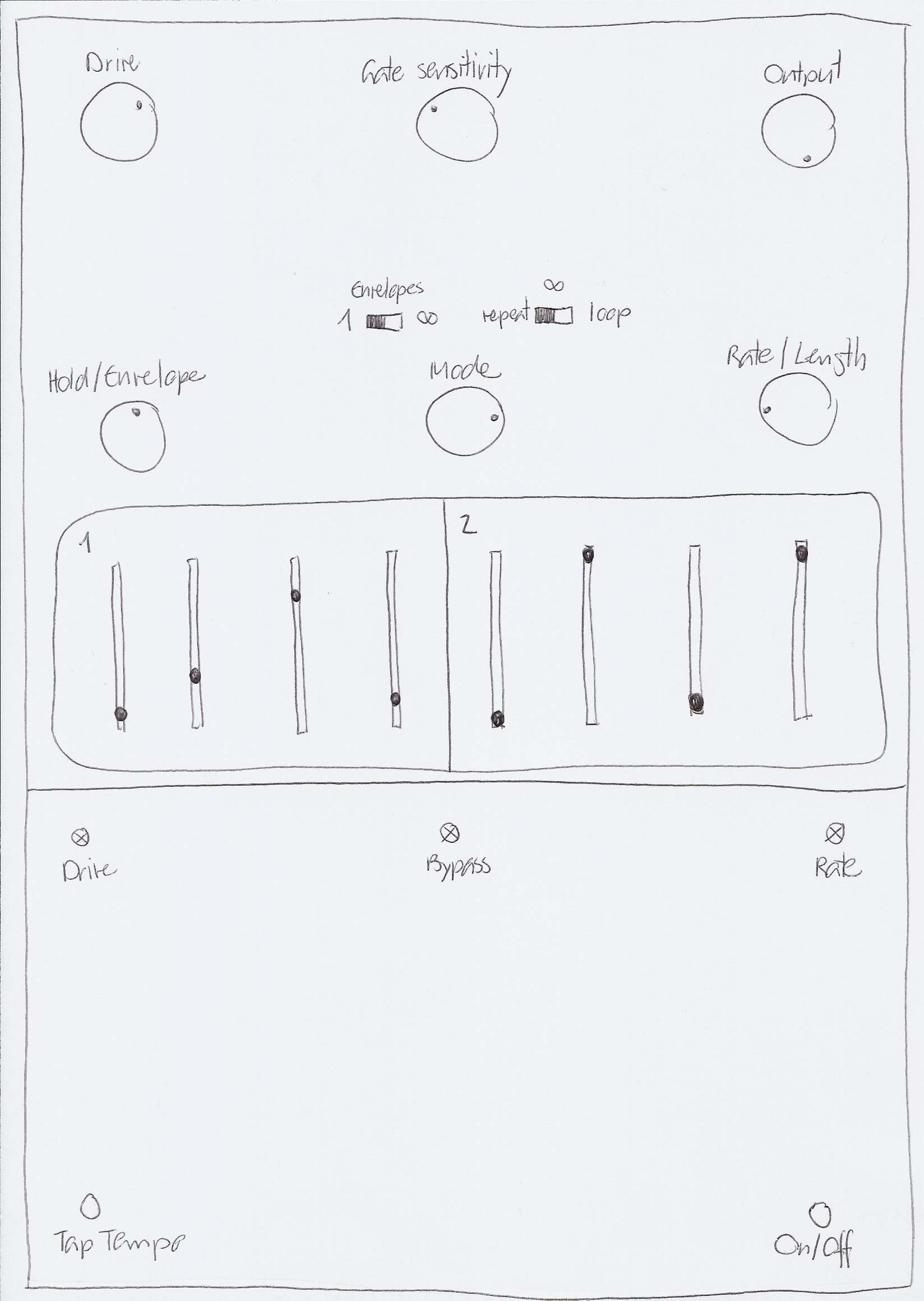
Here is my latest final sketch of the missing MF-109M: :sunglasses:

The whole layout now tries to use the familiar MuRF-layout.

Stomp switches and lights:

  • The on/off switch and light act like on all the Moogerfoogers. Two different “on” colors could indicate whether your envelopes are repeating according to the rate knob, or looping.
  • The drive light has the same function with the three different colors
  • The tap tempo switch could have two different modes (like the tap tempo switch on the 104M and 108M): In one mode you could trig gates with it, and in the other you could tap in the rate. You could change modes by pressing the switch for a few seconds, and different lights would indicate the current mode you`re in.

Sliders:

  • The sliders have different tasks, according to the position of the Mode knob. Sometimes they are divided in two groups of four, sometimes all eight sliders work as a whole.

Knobs and switches:

  • Drive and Output do the same as on the other Moogerfoogers.
  • Gate sensitivity does what it`s been doing since the beginning of the thread: Setting the threshold (input amplitude) above which a gate is generated.
  • The Mode knob (12 positions like on the MuRF) is where it`s getting different and interesting. This knob tells the 8 sliders what their job is: Controlling envelopes, amplitude, stereo panning or two out of the three together.
    Mode 1: Section 1 = ADSR left channel, Section 2 = ADSR right channel (parallel)
    Mode 2: Section 1 = ADSR left channel, Section 2 = ADSR right channel (series)
    Mode 3: Section 1 = ADSR both channels, Section 2 = 4-step pattern controlling amplitude (slider down = no sound, slider up = full output) → new step with new gate
    Mode 4: Section 1 = ADSR both channels, Section 2 = 4-step pattern controlling stereo panning (slider down = left side, slider up = right side) → new step with new gate
    Mode 5: Section 1 = ADSR both channels, Section 2 = no function (slave to Section 1) → same envelope for both channels
    Mode 6: Section 1 = ADSR left channel, Section 2 = no function (inverted slave to Section 1) → crossfade

Mode 7: Section 1 = 4-step pattern controlling amplitude, Section 2 = 4-step pattern controlling amplitude (in series = 8-step pattern)
Mode 8: Section 1 = 4-step pattern controlling stereo panning, Section 2 = 4-step pattern controlling stereo panning (in series = 8-step pattern)
Mode 9: Section 1 = 4-step pattern controlling amplitude, Section 2 = 4-step pattern controlling stereo panning
Mode 10: Section 1 = 4-step pattern controlling amplitude, Section 2 = 4-step pattern controlling amplitude (ampli-pan mode: the louder a sound gets, the further it moves from left to right)
Mode 11: Section 1 = 4-step pattern controlling amplitude, Section 2 = 4-step pattern controlling amplitude (subdivision mode: the tap knob sets the tempo for Section 1, the rate knob lets you choose between different subdivisions for Section 2)
Mode 12: Section 1 = 4-step pattern controlling stereo panning, Section 2 = 4-step pattern controlling stereo panning (subdivision mode: the tap knob sets the tempo for Section 1, the rate knob lets you choose between different subdivisions for Section 2)

  • Hold/Envelope: In modes 1-6 you have an ADSR envelope, and this knob lets you dial in the length of an additional hold stage. In modes 7-12 you don`t have an envelope, so this knob becomes an envelope knob just like on the MuRF.
  • Envelopes switch: Position 1 means that every generated gate trigs an envelope. Position “infinite” means that envelopes follow each other without being triggered.
  • “infinite” switch: Repeat position means that envelopes are triggered according to the speed of the rate knob. Loop position lets the envelope, well, loop freely
  • Rate/Length: When the “infinite” switch is in repeat position, this knob controls the tempo of the triggering. When the “infinite” switch is in loop position, this knob controls the overall length of the envelope (affecting every part of the envelope).

Inputs and outputs:

  • MIDI
  • Audio in 1
  • Audio in 2
  • Audio out 1
  • Audio out 2
  • Gate sensitivity in
  • Gate in
  • Rate in
  • Gate out
  • Envelope 1 out

You could feed this thing a stereo sound, two different sounds, or even a mono sound. One of the Audio inputs could act as a “doubler”, so you could generate stereo sounds from mono sources (a beloved quality on other Moogerfoogers).

I think that this is the most refined of my ideas so far, but it could be complicated to get used to. And it wouldn`t strictly stick to the “one knob per function”-credo. And it has no mix knob - but would that really be necessary anyway? :unamused:

Cheers, radioland

http://www.ehx.com/products/super-pulsar

While it’s not a Moog, it does contain some of the ideas and abilities we have discussed here. No CV ADSR out, but some cool features none the less…

Also, not sure if this has been mentioned in this or similar threads (I didn’t read every entry), but don’t forget about the minitaur.

The minitaur is roughly the size of a 251, and when used as a module, it can do some amazing stuff. No CV out, unfortunately, but with the newest OS, you can remap two CVs and a CV gate in to pretty much anything the minitaur does.

Even without engaging either of the oscillators, you can treat audio through with an amp and a LPF, both with ADSRs. You also get an LFO that can be applied to those, plus the Minitaur does CV to midi conversion. It sounds nice when you run the audio in hot, too.

You can pick them up for around $375 used with some regularity. When I get back to my Voyager in the States I’m thinking of using my Minitaur to add another ADSR amp stage to the Voyager so that I can run a minifooger delay in the Voyager’s send fx. That way I can use the Minitaur as the ADSR amp to do, for instance, short plucked sounds, while still having the Voyager’s amp release time set to infinite so that all the echo repeats are treated by the Voyager’s twin filters.

All that being said, I’d totally buy a Moogerfooger VCA, haha