In my case, MIDI control of the ‘Globals’ is real a game changer. I made an editor on Max For Live, that allows to automatically load all the correct settings (round-robin mode, voice allocation reset mode, etc…) with the song.
Doing this from the synth takes so much time. Figure out where I put the manual, enter Global mode, fuck it up, reset Globals, make changes, etc…
I’ve been keeping the synth because I absolutely love the sound and the interface, just in hope that they would fix what they broke.
Please, contact the support !
Just want to add one thing more.. In order to play really flawless and beautifully in mode 4 (paraphonic) - do not use multi trig. There are some subtle bugs that is not compatible with paraphonic. However multi trig works well in monophonic mode. Another one is the restore stolen note - 4.5 in global settings. Set this to on. Then it plays really nice.. The hardware in the synth is impeccable. I don’t care so much for the small improvements of firmware - best would be no firmware at all for my part  Complexity and bugs rises with digital stuff. However I do miss the note latch on hold..
All that being said, I can understand some who use the synth more as patch tool and do cool soundscapes etc. and don’t play much with keyboard. I use it mainly for pads and polyphonic playing so response is very important to me.
In my case, MIDI control of the ‘Globals’ is real a game changer. I made an editor on Max For Live, that allows to automatically load all the correct settings (round-robin mode, voice allocation reset mode, etc…) with the song.
Doing this from the synth takes so much time. Figure out where I put the manual, enter Global mode, bleep it up, reset Globals, make changes, etc…
I’ve been keeping the synth because I absolutely love the sound and the interface, just in hope that they would fix what they broke.
Please, contact the support !
In my case I don’t need to go into global settings very often. When I am happy with it I can let it be. Thus I have less need for an editor. I also have two grandmas that plays perfectly with test firmware and for those I change it with https://marcora.github.io/grandmother-editor/ . I agree it is more comfortable than the keys.. There are also a similar one for Matriarch (that I cannot use as it is now with firmware 1.1.0). I downloaded those webpages locally so I don’t have to be on the GitHub page every time.. (tip!)
Yes I agree.. Hope moog soon fix this in new firmware and at least let the user decide the time out ms for the poly-play. And we have their word that they will fix it soon!
English is not my native language, but this means that it’s not fixed, right ?
KNOWN OUTSTANDING ISSUES AS OF V1.3.0:
• Global: Delay Sync CV Bend - Can be stepped/quantized when it should be smooth and continuous.
• Global: Keyed Timing Reset - Does not work while HOLD is active.
• Global: Sequence Keyed Restart - Seems to have no effect.
• Global: Sequence Random Repeat - Seems to have no effect.
• Global: Load Default Settings - After performing this command, global mode acts like A#3 is constantly being held down. Globals don’t work again until power cycle.
• Send Program Change - Seems to have no effect.
• Paraphonic Mixer Gate Length - Mixer gate can stay high longer than keys are pressed.
• ARP sends Sustain CC while Hold is active - HOLD should send sustain CC when Arp/Seq is inactive.
Correct. I just flashed 1.3 and went back to 1.1. Such a bummer.
Thanks for confirming.
Anyone wants to buy a second-hand Matriarch in France ?
I understand the disappointment here. However, today I started wondering what the proper behavior should be for paraphonic playing. It seems like there are conflicting requirements and the firmware has to make an educated guess, which might require some delay.
For example, if I am holding down a bass pedal tone and playing block chords, organ-style, on top: I would like the chord notes to cut-off as soon as I lift my fingers. On the other hand, if I am playing percussive piano-style chords with no bass, I would want all the notes in the chord to remain active while the sound decays. If the firmware automatically cuts out tones as fast as I lift my fingers, then at best, the piano-style sound would end up with one note remaining while it decays.
This seems like a no-win situation for the firmware. Has anyone got an idea for how this could be made intuitive to “do the right thing” in these two situations? I’m thinking that maybe Moog’s implementation is to hold onto all notes for a period of time to see if the gate falls (keep all notes and decay) or the gate remains and fewer notes are pressed (then drop notes in the mixer). I guess they could add some global choices for behavior, but such parameters might get crazy to manage. And simple parameters would still not allow any mixed behavior.
It really does seem hard to define how a paraphonic synth should work in a natural manner!
If Moog can make the gate variable in a global setting then I’m all for it, but its current firmware setting makes it feel sluggish to play. It works great for me at 1.1.0 so I guess I’ll just stay there until the next update.
Agreed.
@sdwillingham, I need to think about your explanations/examples, as it’s not super easy to figure out if there is a way to find a behavior that would suite any plotting style.
But, if there is no “perfect” solution between 2 behaviors, then I wouldn’t mind having a Global Setting for this.
Bump.
Let me play short notes please 
I don’t think anyone from Moog actually reads this forum. Which is a shame.
Therefore, it will be worth e-mailing them. However, I have found that only about half of my e-mails are actually replied to, so you may have to keep trying.
I’m also still waiting for the filter tracking to work properly in all portamento modes, which currently it does not. It only works on the default glide setting.
I’ve tried the email way of course. I’ve got something like 10% of replies.
I even reached them by phone twice (from France) and had a 50/50 experience.
One person was really helpful, the other was just arrogant and unfriendly while I was struggling discussing in English, by the phone, which is kind of hard when it’s not your native language.
Almost a year since last firmware, in which they acknowledge the issue in the release notes.
That’s nice to not deny the issue, but maybe time to fix it ?
Just saying…
Oh look! A slap in the face from Moog!
I got a letter that there’s a new MUSE firmware today. How exciting. Love that for them.
Hopefully it will get more buggy as well.
So, the plan is to never fix it ?
According to Moog tech support, extending the paraphonic note gates after key release was intentional to avoid copmletely missing quickly played notes.
I did some measurement and compared Matriarch’s paraphonic gates to a vintage KORG Mono/Poly.
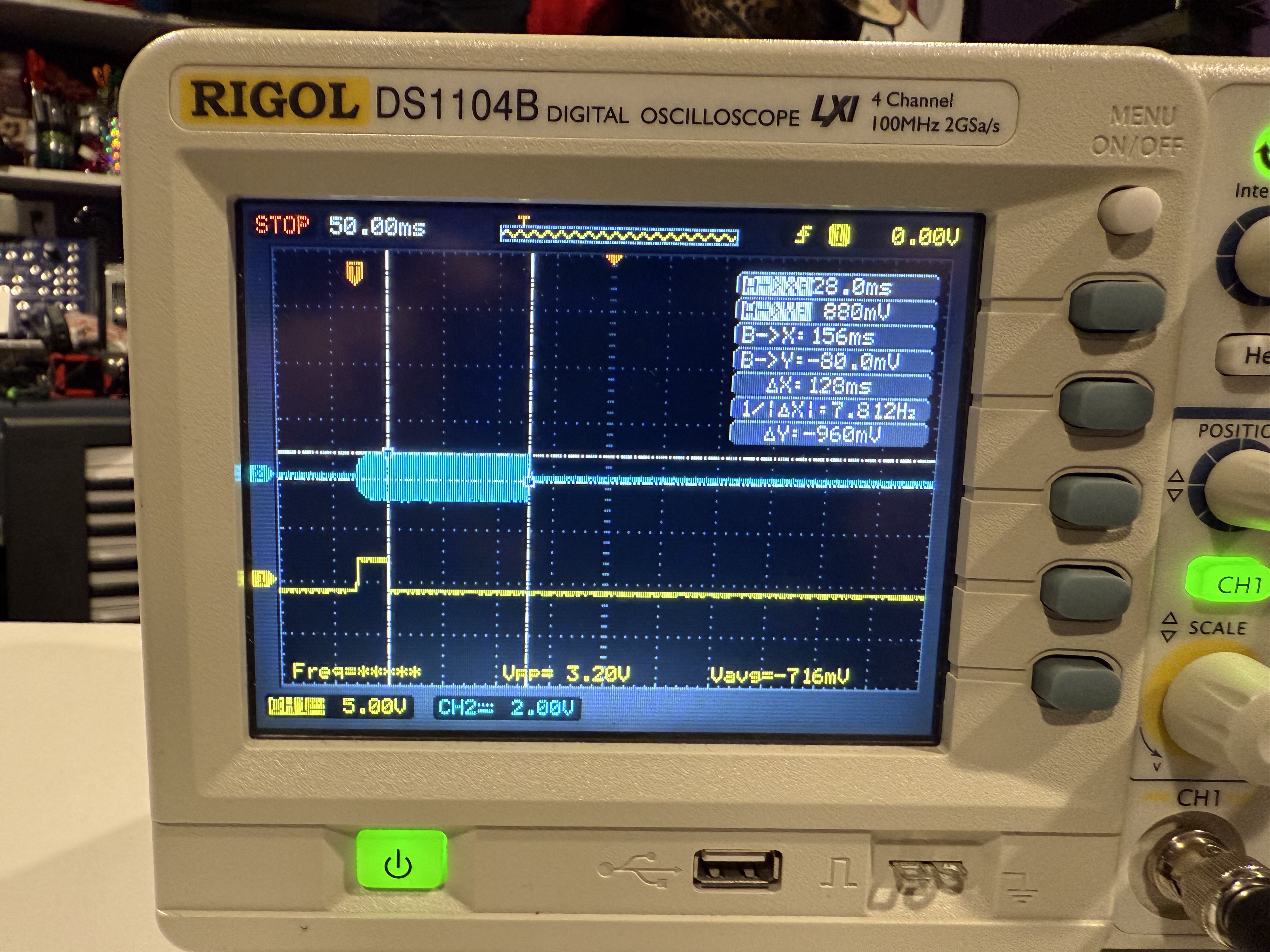
Here’s the Matriarch response to releasing the 2nd key in paraphonic mode, and Osc 2 actually muting. It’s about 125ms from key off to mute.
Here’s the Mono/Poly doing the same thing. Note that it mutes Osc 2 about 40ms after key release.
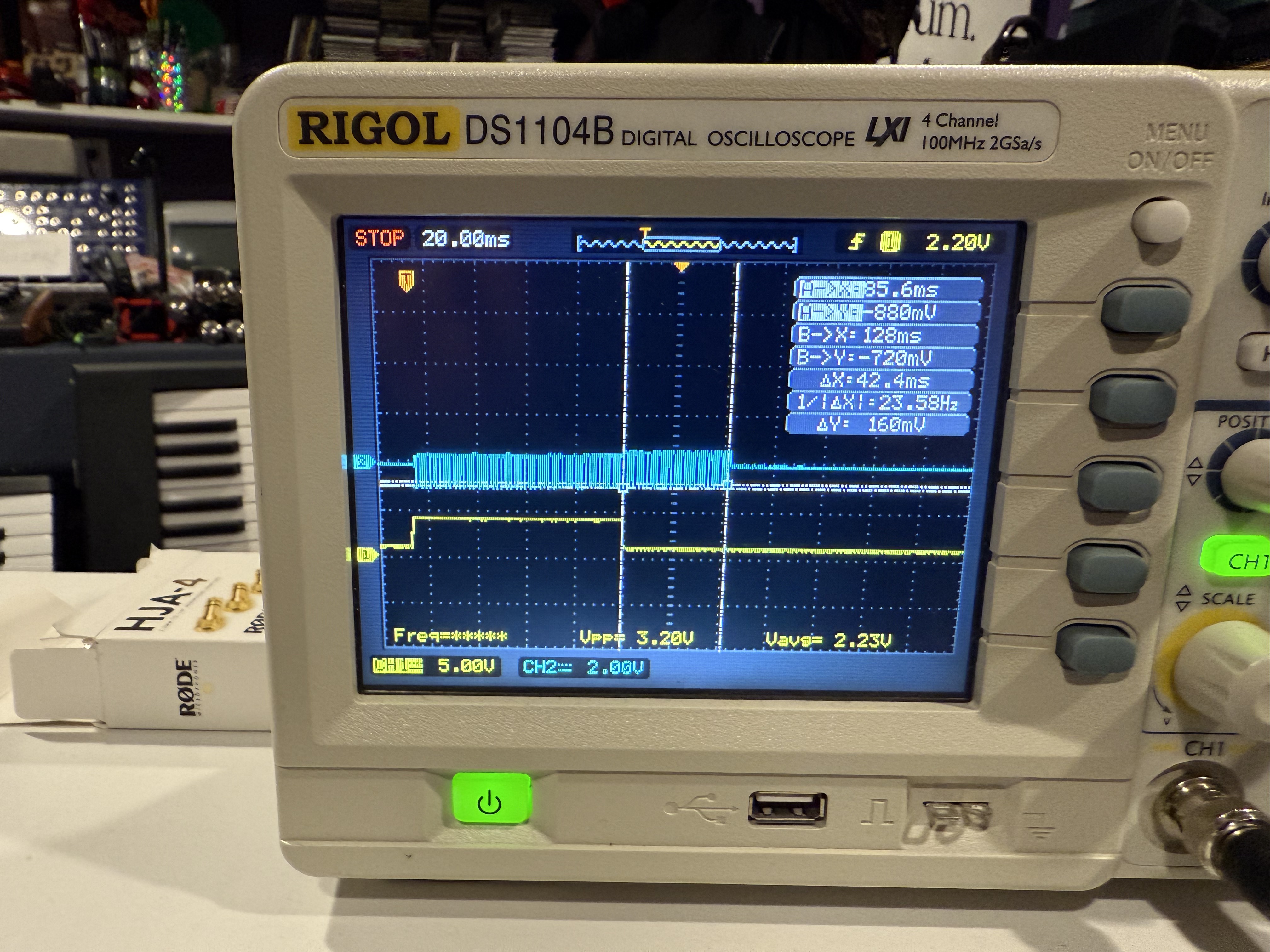
Consequently the Mono/Poly feels more responsive to paraphonic playing than the Matriarch.
Making the paraphonic gate hold time configurable in global settings would be a nice solution.
Thanks for the tests.
I never felt I was missing notes on the previous firmware, so why fix something that isn’t a problem ? 
Bump…
I’m so frustrated. (but you got that already)
Guess what ? I’m still angry and frustrated. Please fix this…..