Analog synths are now craftmanship :)

Ironic to see Moog over the last decade sell the craftmanship angle. We see the final assembly like its some specialist craft passed down from generation to generation. The actual clever bits are ignored - the design and the PCB. In the '60s the sound was new and completely rejected by traditional musicians, everyone I knew scoffed and dismissed electronic music as a fad. But now the technology is unremarkable and even turned around to be some grass roots home made instrument lovingly made the old fashioned way.

I feel so lucky to have grown up in an age where electronic synthesis began and then matured.
B

My favorite quote is from Bob about these new electronic instruments and their place in time.

“The idea that some musical instruments are more natural than others is pure nonsense. Except for the human voice, all musical instruments are highly contrived, wholly artificial, and utterly dependant upon the.most advanced technologies of the time in which they are developed. When we view musical instruments this way, we see the widespread use of electronics in the production of the music of our time is not a break with tradition, but a clear continuation of it.”
Robert A. Moog

I like the craftsmanship of the older Moogs, late 60’s early 70’s. Certainly built to last, and targeted toward the professional market. The Voyager is probably the closest to that type build quality of old.

I wish I had that quote in 1969!
B

Early Moog Music products were built with “army rated” in mind. There was a lot of heavy duty components, some even overkill (like 1 watt resistors used for audio signals sometimes :unamused: :wink: ).

The Voyager, while maybe not as rugged as far as electronics is concerned, is still mostly made by hand with attention to detail by a group of about 50 dedicated persons who love what they’re doing. And THAT is quickly becoming a rarity in these modern days of everything Chinese-made.

The only overseas company with the same mentality is probably Boss. Yes the Roland owned Boss brand in Taiwan makers of world renowned effects pedals. It is a surprisingly small company but with a similar philosophy to Moog Music. Each pedal is hand made, yes hand made by a group of about 60 employees. Every single components are individually tested before being used. Down to the smallest resistor. That’s probably why they can offer a 5 year warranty.

But that is the exception to the rule.

“Army rated” sounds like sending detuned saws to the disrupt the enemy…

Wondering how reliable the original modulars are. Not in tuning, but in failures. I’m asuming that modern board construction will prove longer lasting and that’s why I won’t buy old analog. What is the typical working lifetime of an original monster?

B

Older point to point and through hole construction at least can be repaired by most techs. Modern board construction (typically SMD unless not mass made…many manufacturers won’t even build through hole boards cost effectively) is designed to be disposable…if you have a problem swap out the whole board, just like a TV. Problem is, where are you going to get a whole board in 10+ years when you have a failure? Surely spares won’t be available forever. Save for custom and/or obsolete chips, most older synths can be restored with easy to get components, and are easier to troubleshoot and mend accurately by a competent tech. How many techs do you know that work with SMD construction?

Time will tell, but I think it is fair to say that most of today’s synths will be in the landfill when they have endured the number of decades that the classics have and kept ticking (with maintenance along the way, sure).

+1 on that !

Aren’t the components, especially semiconductors, longer lasting now? There was more variability of specs and less lifetime reliability back then.

B

I have a very low mileage 1969 R.A.Moog here that will probably outlive me. Still plays great, and it is a precision instrument. Very well designed and not failure prone. I’m shure any instrument that was a beater and abused will have problems. Many of those university Moogs were not owned by a caring individual, and did see some heavy use. But for the most part, they used military spec. parts that will outlast anything in a resonable price range today. And I think price is the factor here. Back in the day those Moogs cost more than most cars. If synthesizer manufacturers used the same spec. parts Moog used in their modular systems, the cost would be ridiculous. Even the Moog modular clones today do not use the same expensive pots the originals used. These parts can still be purchased new, but cost close to $50 for a potentiometer. No one will buy them if they cost too much.

Here is an example of the hardware used on a Moog modular.

Those Centralab rotaries Moog used could probably launch weapons. While the rotaries they put in modern synthesizers are probably not reliable enough to start a car. I’ve had more failures from normal use with modern equipment, than I ever had with the good vintage synthesizers. I needed to replace two rotaries on modules less than a few years old.

The same with those AB type J pots. Super precision feel and will outlast those PC mounted pots we see on every synth made today. But no one could afford them if they still used quality parts like that. This is one of the reasons you still see Minimoogs playing today. Moog used quality parts and construction. I have sealed modern pots that are scratchy and can not be easily cleaned. And they are less than 10 years old. While the 44 year old Moog works perfectly.
The synths they make today are affordable for a reason. Lower cost and lower quality parts. The Voyager is the closest you can get to the old style built to last Moogs, and the price tag reflects it.
A bit of analog craftmanship, if you can afford it.
The old Moog modulars really were built to last though!

Wow, interesting! Thanks for the view.

B

On the basis of the subject title alone (Analog synths are now craftmanship), I respectfully disagree.

Years ago, PC boards were done by hand. Craftmanship.
Today, one can draw a schematic on a computer and it can automatically generate a PCB from that drawing.

The parts of the past were often much stronger.
Many were first designed to meet military specs.
There was hardly a US consumer electronics industry for a while.
If you bought a portable AM transistor radio then, there was a good chance it was made in Japan.
Why? Because US components were larger.
Same for cars too: eariy US cars were always bigger than early Japanese cars.

But these are just isolated, arguably comments above.
My larger concern regards construction and all-around complete designs.

Today there are people building synths that have no idea about RFI emissions.
Some are clueless about mechanical engineering despite then being little Einsteins in EE design or programming.
Many don’t understand basic electronics and have learned only what they needed to get from point A to B.
Say “induction” to them and they make look at you like the RCA dog.

For example, they may make a Tesla coil, but have no clue about high-frequency/voltage burning and emissions both at their core and resonant frequencies.
In short, they’re not well-rounded engineers; they’re talented and applied DIYers often with some business acumen.
This is no slams to them at all though. It’s a criticism based on the public perception that older and newer things might be equal.
Indeed they may be equal until someone tries to export their wonder-goody to another country and finds themselves amongs ROHS or FCC compliance demands.

And if you think I’m just a big bag of woe here, think again.
I’m digging seeing what many people are making today.
Yesterday’s engineers were rarely artists.
They followed directions and procedures to build something.
Without such frameworks in place, today’s builders can enjoy journeys through creativity unencumbered by rules.
(I draw the line at some circuit bending tho. Currents and voltages don’t know Picasso.)

So anyway, my opinion is that our technology is far advanced over yesteryear, but that many of today’s offerings are constructed much more poorly.
Not built to last time, nor everyday repeated usage.
Where yesterday a maker might only have one choice for a particular switch, today the common denominator can be price and with that thinking, quality goes the other way.

I’d love for those that haven’t had the opportunity to compare, say, an Arp 2500’s parts to many instruments today.
You’d find the older devices used metal shaft pots, instead of plastic and on and on.
No, today’s analog synths are not so much craftmanship (exceptions withstanding), but moreover they’re now far more controllable and capable.
I’d rather be in an accident in a '57 Chevy against a 2013 Kia.

Though I concur with your statements about synthesizers, I respectfully disagree with your car analogy —> the 57 Chevy did not come equipped with seat belts from the factory (not to mention air bags or any other safety features we take for granted), and though with all that mass and power behind it it could do considerable damage, having been on the receiving end of TWO totaling accidents while driving Kias (not 2013 models, mind you), the way that Kias are built to push together without compacting the passenger (exceptional semi truck induced wreckage, notwithstanding) lead’s me to believe that the Kia is a safer bet. The car may be toast, but the people inside will likely be fine, which in the case of a vehicle accident…is truly all that matters. On the other hand, the 57 Chevy would still mostly resemble most of its original shape, but the passengers are substantially more likely to be injured or killed.


:slight_smile:

As long as it has seatbelts retrofitted, yeah. And the Kia T-bones the Chevy on the passenger side. :wink: The early Moog modulars were built like tanks because those components were what was available. They weren’t using Japanese components, because Japan wasn’t exporting parts to America. Even if they were, Japanese components back then were worse quality than Chinese components are today. I’ve taken apart many 1960’s and 70’s era radios and tape recorders. Even the high end Japanese cassette recorders were made with low quality components up until the eighties. It’s not always about saving money or going for the highest quality. It’s about what parts are available.

I respect your comments, but was I truly remarking about overall build quality, not technological features or advancements.
I tried to clearly define the differences between technology and quality of parts and perhaps I failed or perhaps there’s always someone who wants to find an exception.
I don’t care. My argument as based upon the subject remains sound.

If we went farther, we’d have to discuss the minutiae of speed and angle of impact and all that and that would take us away from the basic subject of craftmanship.
We are talking about things that are crafted, not people.
Whether I died hitting that KIa, that '57 probably wouldn’t be declared “totaled” by an insurance company like the Kia would.

Again… respect… but I view such comments as a left turn from the subject.

Just to clarify, I did have a :slight_smile: at the end of my post, which was meant to imply silliness…


I understand the point you’re trying to make, but the car wreck analogy does not work for me because in the end the outcome of myself and my passengers is far more important than the execution of American construction and available parts my car was constructed from if the design itself is reckless. That’s a lot like saying you’d rather be in air travel accident in a Zeppelin instead of a 727…


I’m just picking on you…don’t take me seriously. :astonished:

I won’t take your “picking on” seriously, I’m just kinda passionate about this stuff and terminology.
I was taking the craftsman’s side where, sure it could have an airbag, but the craftsmanship of that bag could suck.
In that case, a head-on collision could mean I’ve got a new passenger, but just need a new window and bumper. :wink:

Tell ya what… you don’t pick on the minor details and I won’t tell anyone what those Moog accessories actually cost you? -)

@Kevin

Maybe a '57 chevy, with its impressive mass, would win over a “plasticky” Kia, but you’d surely get a cut lip from hitting that massive all-metal steering wheel and dashboard in the Chevy ! :laughing:

Just kidding with ya. :wink: And a Kia, or any small car of 2013 for that matter, is certainly not as comfortable on rough roads as a good 'old big American car ! (how I miss my 1977 Chevrolet Monte Carlo, 8 miles to the gallon :open_mouth: but what a comfortable ride !)

I strongly agree on most of what you wrote about electronics technology today. However, I must point out that in switching type PSU, RFI and high frequencies must be very precisely controlled (per Government regulations and reliability concerns) otherwise it won’t get approved by testing laboratories. But today’s engineers don’t even have to calculate anything, the CAD will have done it for them most of the time…

No secrets here, my 1125 and 1150 have been sold for a long time…they only cost me a half-functional pawn shop Tascam MS16 + a new reel of 1" tape + your services + eBay fees…so…I definitely came out ahead on that one…but it was a substantial risk not being able to test before taking them and an investment of time before I could make any money off them. :slight_smile:

Yeah, I once had a '67 Mustang Fastback.
Restored and with shoulder belts.
What what I feared most though was that steering wheel.
Hard as a rock and no padding at all.
But it was crafted pretty nicely. :wink:

But back to Moog, craftsmanship and technology…

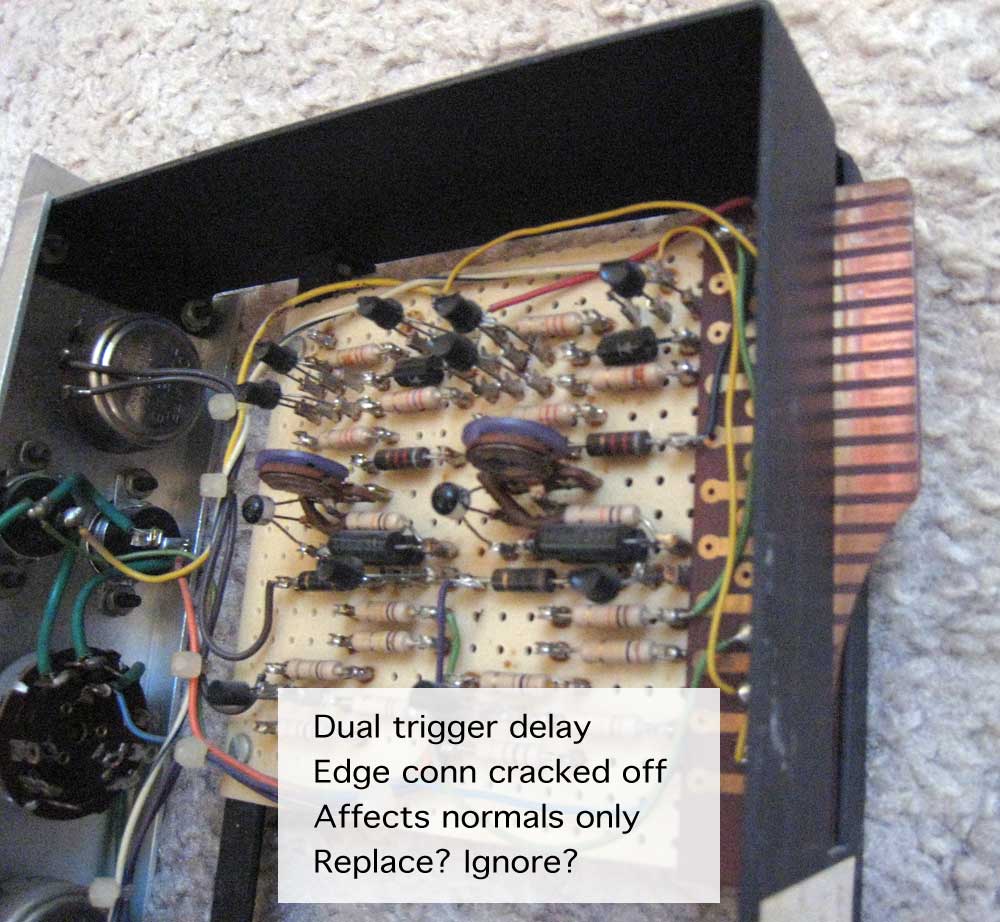
Here’s a pic of a Moog module before they had glass epoxy circuit boards.
The material for the edge card is phenolic, a kind of paper and resin mixture.
It’s brittle, can absorb moisture and for the most part inferior to today’s board materials.
(Please ignore the notes on the photo, this is how I sometimes communicate with a client to ask a question.)

Is this a prototype or was it actually in production and sold to customers ? If so, this must be a very very early version of modules made in the basement in Trumansburg (probably assembled by Bob himself)!?