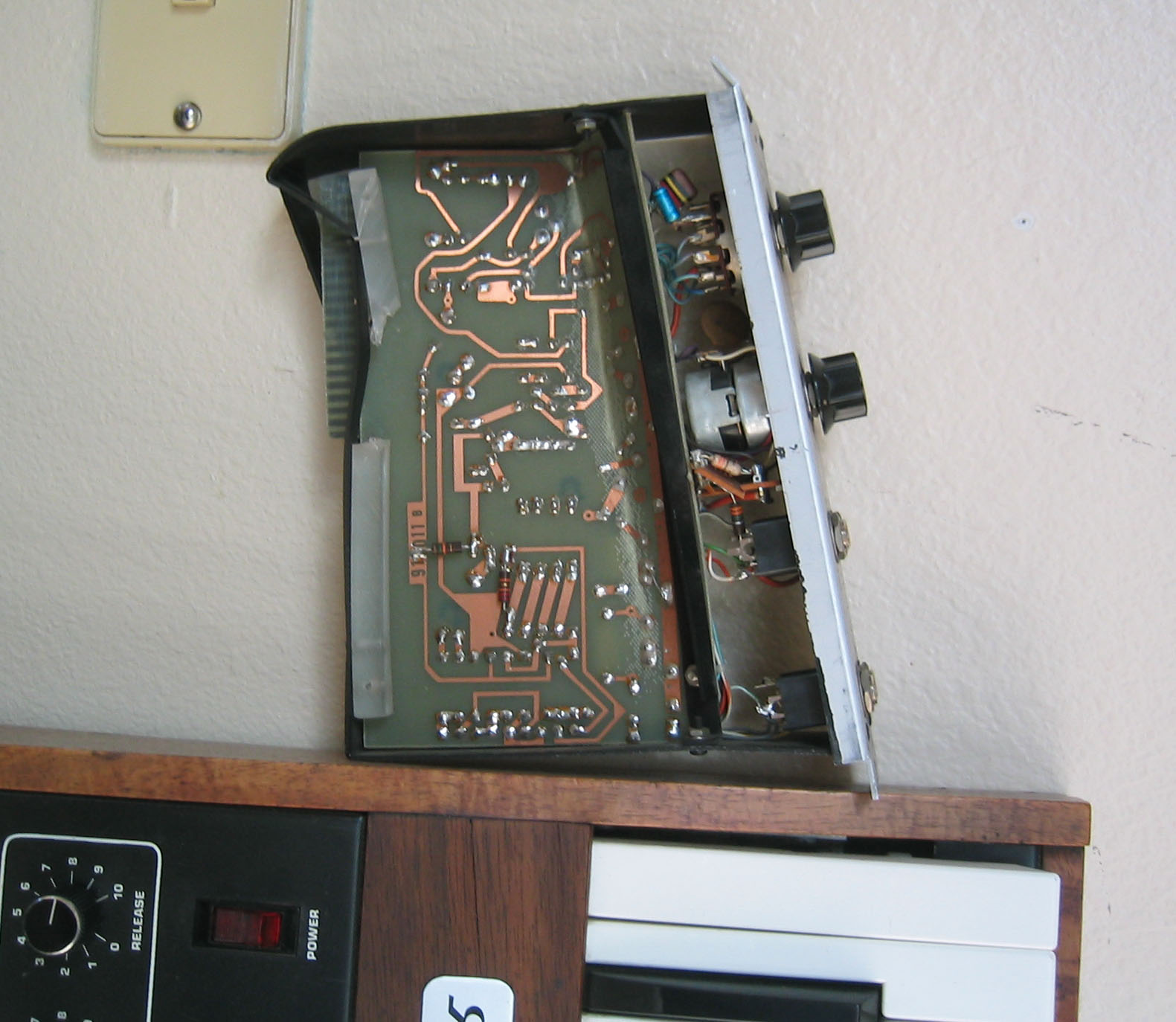
I’m not sure that photo is helping the cause of old is better
Lots of things ran hotter with unneccessary power comsumption and there was so often mains hum and semiconductor noise in the background. That’s my recollection when that gear was brand new. I suspect that really low noise electronics is much more recent than we like to think.
Well this is very old. 44 years maybe?
That stuff is brittle!
But even glass epoxy has its limits.
In this case it was Fedex…
But you do bring up an interesting point…
Many people hark to own the earliest examples of instruments.
The white faced Odysseys, for example.
Many times these designs were much cruder in design and construction.
I suppose those are the yearnings of a collector or a museum and so be it.
There they may have value due to their age.
As for regular users, I’m not big on pursuing the first issue of anything.
I want the bugs out first.
Some gear did run hotter.
In generally, Moogs didn’t.
Being mostly discrete and without many (or any) ICs, they really didn’t draw that much current.
TVs and early radios are another thing altogether.
Hum could also be worse because for a long time good grounding and 3 pronged devices weren’t available.
Grounding some old stuff could even damage it. Not grounding it could damage you.
It’s also true that some early semiconductors were much noisier. That’s a fact.
But in terms of musical tone, this is an highly arguably point whether it’s a feature or a bug.
If you listen to the static pitch of a Moog 901B A/B’d against a CEM3340 oscillator, you’ll probably hear the difference.
The former is figuratively like a violin, while the latter like a razor blade.
An oscilloscope can validate this, especially one with a really precise timebase.
This is an interesting debate, but difficult to pin down. What makes a great musical circuit? Where do you trade off quality and robustness for sound, interface, and functionality? It’s all personal taste, but one thing I do know, is that looks have a much greater part in it than people are willing to admit. For instance, the Shadow Hills Mastering Compressor is one of the most beautiful piece of audio electronics I have seen (the knobs and lights and magic eye are stunning). It is over $7000 for a single stereo compressor. While it sounds great, there is nothing about the sound that justifies the price, yet it is a huge seller, a staple in mastering studios and many recording studios. Many probably didn’t even hear the thing before buying it. Looks are important to people, and in many cases, trump everything else.
I can think of countless examples where having good looks and a high price tag were clearly more important goals to the manufacturer than producing a decent product. Mastering houses can justify spending so much on their audio chain because they generally get paid pretty well for their services. Not only is having specific pieces of gear impressive to its owner, but to any prospective client as well. Not to imply that gear is everything in the world of mastering, but…if I am paying big money to get my record mastered, am I willing to pay more for the big fancy room than a studio that only uses Ozone or T-Racks? (assuming both mastering engineers are of equal skill)