I had that idea in my head for a long time - how can you store an analog preset in synth’s digital memory when it is a position of knobs which, being analog, are nothing but resistance level…
So I took a screwdriver and checked - what a pity, Voyager is not analog, it is DIGITAL… A kind of AWM, sorry…
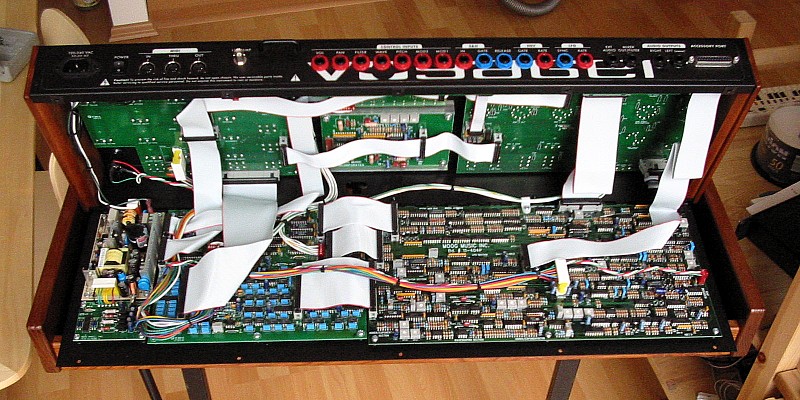
when you open the Voyagers back and see its inside from the back side, you see the huge analog board with 50+ analog CV inputs at the right side.
(c) Till Kopper
The digital board on the left (partly burried under wide ribbon cables) scan the pots, switches, keyboard and the touch field by measuring the position. The convert this into a digital value for storage. This stored value (and not the sound generated) is then feed into an D/A converter to control the full analog oscillators, envelopes, filters, audio path. So the knobs are not straight attached to the sound generation. But the sound is created 100%analog.
The analog board uses CV for all parameters. Including each stage of the envelope, the mixer settings (via VCAs). So the analog board got some analog functions not even available as CV on the Moog modular. For example the 4 stages of the envelopes. So the technical break through was the complex analog board for the Voyager.
So before posting your “what a pity, Voyager is not analog, it is DIGITAL”, please learn what is digital and what analog in the Voyager. Just the patch memory and the midi is digital. The sound is 100% generated and controlled analog.
(Edit: typo in last sentence: 10% meant of cause 100%)
Back in the day, we called something like a Voyager a “Hybrid” synthesizer. A mix of both digital and analog. It seems today poeple call a hybrid with an all analog audio signal path an analog synthesizer. I find that interesting, as if saying it has anything digital is bad, so they put the analog tag on it. It is important to know what you are playing and what control you have over what you are playing, no?.
I always thought of the Voyager as more of a hybrid and the Voyager Old School for those that wanted analog control.
If the definition of analog is that strict, then there are no analog synths with midi ever possible. And only the CS80 like approch for storing patches would be analog at all.
And the Voyager OS has also some non analog parts inside. The keyboard action from Fatar can’t produce analog voltage to feed the oscillators. There is some logic involved to get the key numbers being pressed and to generate the CV to control the synth part. The old Moogs used to have a full analog keyboard action based on voltage dividing by fixed resistors and a simple gate contact to generate the trigger and the gate for the envelopes.
The Voyager Old School would not be fully analog if you used a digital camera to take a pic of the front panel for patch storage. You would have to use a film camera and take it to a drug store for prints. This is the seriousness of arguing anything digital must be bad. Digital is excellent at keyboard scanning, patch storage and communicating between devices (MIDI’s limitations are due to its age, not just being digital).
Any manufacturer would be stupid not to use the best technology available. That includes Moog.
Well, sort of? MIDI is an acronym for Musical Instument Digital Interface. How is a digital interface not digital?
It just strikes me as funny that no one seems to want to admit that there is digital circuitry inside something like a Voyager or any other modern digital-analog hybrid synthesizer.
Back in the 70’s, manufactures were proud to announce their synthesizer used digital technology. The Prophet V stated right in the manual " The term Digital-Analog Hybrid is often used to describe the Prophet". But today the term “Pure Analog” would be used to describe a Prophet V. One would have to ignore the Computer Board inside with it’s CPU and digital components. You knew there were trade offs with this type technology, like the steppeng when turning a knob that was digitally scanned. This is why today people get dissapointed with a hybrid, when they hear the artifacts of the digital scanned controllers. And there are quite a few people that believe a hybrid is pure analog, when it is not.
As a player it is important to me not to expect a scanned controller to act the same as an analog device. A MIDI mod wheel versus an analog one is a good example where I will use each one in a different way. It’s good to know where, why, and how things work on your instrument, and apply that to your playing style.
So for the OP, of course the Voyager is a hybrid of both digital and analog. How else would it work?
My 2005 Voyager was making some really strange sounds, so I opened it up to take a look. Turns out I had to order a replacement tube set from Moog. But it still makes strange sounds…
That’s like saying a guitar is not acoustic if it has “pickup” written in the metal used to make pickups where the pickups normally would be if the guitar itself was the opposite, i.e. the words “acoustic guitar” written in the wood that the guitar is made of in the pickup’s normal position, even if it was an electric guitar!
The bottom line is that the words acoustic, organic, electric, electronic, digital, and analog, discrete and integrated can all be used loosely. I saw an all “acoustic” concert where the bass player was playing a hofner beatle bass. There are things called digital microphones now, how is that possible? Is a guitar with active pickups technically an electronic instrument?
yes, any synthesizer with midi port, or 5 volt power rail or cpu or dac / adc or presets are digital synthesizers. almost all the synthsizers have analog circuit here and there, at least at the final audio output stage. wait a second, is hammond b3 also digital, with reverse color key presets? maybe strat is 5 bit digital and les paul is 2 bit digital guitars? anything that works with counting or on/off states is a digital computer. anything that “measures” with continuous value is analog. geez, fretted instruments are digital too. saxophone, trumpet are literally digitally controlled. acoustic piano is an 88 bit nonelectrical-digitally controlled instrument too . vocal and violins are the only true analog instruments.

 Go close enough, and the earth IS flat
