I’m thinking of assembling a collection of .com modules to supplement my Moogerfoogers. This wouldn’t be a stand-alone system, because I’d try not to duplicate much that the MFs already do. Has anyone here done anything like that? Any pitfalls to be aware of (either in general, or in terms of .com-MF compatibility)?
You shouldn’t run into any issues. They’ll work great together.
DotCom is a better choice than EuroRack because all your stuff will be 1/4" plugs.
If you haven’t come across STG modules before, I’d also suggest checking them out.
All of his “MU” format stuff is compatible with a DotCom rack and power supply. http://www.stgsoundlabs.com/
Good to know, thanks. While I’m at it, maybe I can ask everyone’s opinion on one other thing. Right now I’ve got a Little Phatty, CP-251, Ring Mod, Freq Box, and Lowpass Filter (all MFs). So I’m thinking that if I got the .com MIDI interface, envelope, and oscillator, that would round things out into a pretty complete system.
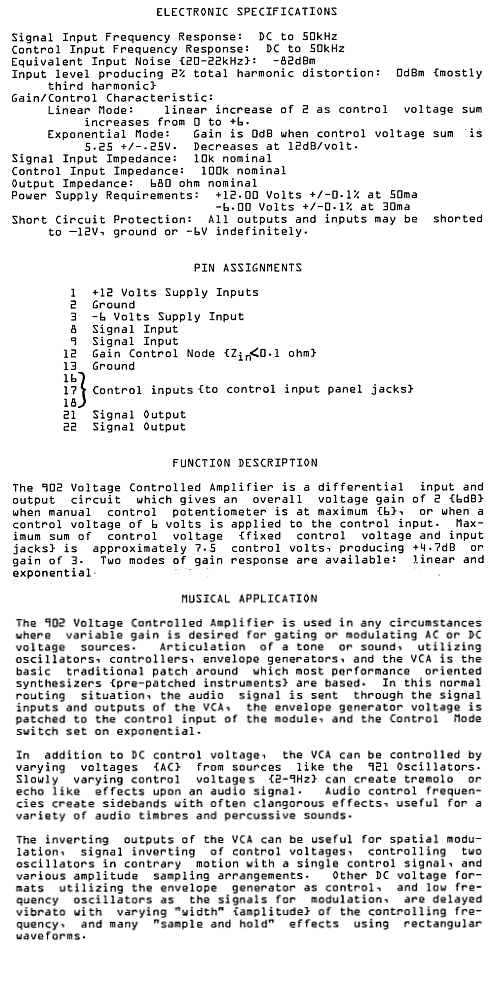
My area of doubt is whether I would benefit much from adding a standalone VCA module. I’m thinking that a VCA module wouldn’t be high on the list, since I’d normally use that for the master volume envelope and this can be done with the Phatty (using the Audio In and Volume CV jacks). But are there other typical uses for a VCA that I’m not thinking of, that would bump it higher on the must-have list?
A Ring Modulator is essentially a voltage-controlled amplifier, one that responds to both positive and negative voltage (a normal VCA only responds to positive voltage). It’s doing the same thing as a VCA: modifying amplitude according to a CV source. So if you replace the oscillator with an envelope signal (which the MF-102 allows you to do) then you should wind up with a traditional VCA type response.
The technique is described in the Lord of the Ring Mod article, which someone has uploaded to the KnobTweak Yahoo Group (look under Files/Moogerfoogers/MF-102).
I tried this with my Frostwave Blue Ringer and got mixed results. I don’t own an MF-102, so I don’t know how well it works on that. A dedicated VCA would always be better though, just because you probably want to use your Ring Mod as a Ring Mod instead.
You can use your Little Phatty in the way that you described. The only time I would think you would want a DotCom VCA module is if you wanted it to be a separate synth, i.e. use it for one sound while the Little Phatty is playing another sound.
This is a great thread. I do have been considering purchasing a modular. At the moment, I have a loss pass fooger. I really love it not as a traditional pedal, but as a way of using many alternative controllers to filter sound. I have been an electronic music composer and musican (experimental, ambient, film/art musc, ect) for a while now but with soft synths and DAW and recently a Korg M3. But now I want to venture into analogue electronics and while I will probably buy more foogers (I can’t resist), I do want to slowly buitd a modular to suite my need specifically to interface with my foogers and M3.
On modulars. I used to know nothing about these but in shopping for one I have come to learn a lot. One thing I dont’ know is if there are adapter cable to go from the various formats but I can imagine that there arn’t. I would not buy a particular format/brand just to be able to use 1/4" plugs.
However, one question I would have is the CV compatiblity of other formats and brands. I know that dot com works but what about Cwejman or Doepfer (these are two brands that I am very interested in).
I am hoping to put my foogers on a tilt rack with other rack electronics and then put a modular on the other side of my Korg M3 and that will create a nice little hybrid system if I also add some patch bays.
Generally now most everything is 1VPO or 1 volt per octave. I think alot of the modern brands are of this nature. It didn’t used to be that way though. In fact some of the old Moog stuff like the MicroMoog isn’t 1vpo. THe Taurus pedals are Hertz per Octave.
I think some units like the Frostwave resonator are capable of putting out more voltages, but just about all synths have attenuators to make them compatible.
Now Im really getting started with synthesis and Im learning lots all the time so somebody correct me if Im wrong. Generally the Old Moog stuff had alot of S-trigger cables to send gates and things, and this was Moog brand specific on those synths. I think Buchla uses 1/8th inch mono patch cables…so really to answer that question I don’t think theres going to be any difficulties in keeping synths communicating with eachother either voltage wise or through some special cabling.
Generally, there are a lot of people here on the Moog forum who are DIY (Do-it-yourself) and they can advise you how to modify a cable or can lead you to someone who can modify them. Synthesizers.com even sells the S-Trig to V-trig cables that will take the s-trig from a Moog and translate that into a cable you can manage.
Others more knowledgable than myself about the particulars of modular synthesis and their componants can elaborate with more detail than I can.
So I just tried using the 102 as a vca(guitar to 101, 101 to 102, envelope out to carrier in, 102 to amp) didn’t get very useable results…BUT I found a way to create tremolo with a swing or triplet rhythm!
I took the 102 carrier out (frequency lo) and put it into the 101 audio in (this makes the envelope stutter) then envelope out on the 101 to carrier on the 102. Then tweak the lfo, frequency of the 102 and the envelope of the 101 til you get a rhythm you like. I wounder what would happen if you replace the 101 with a murf ???
EDIT just tried with the phaser (envelope out to sweep or sweep in) Veeerrry cool stuff going on
First of all, what EricK means about the Taurus pedals is they are Volt per Hz. Just clarifying, as a n00b would be confused. I excel at modifying stuff, and cables are really easy. PM me if help is ever required in modding cables, as I know of several vendors on the web who sell 1/8" and 1/4" stereo and mono plugs. Not hard to make a cable like that, and Radio Shack sells a cable like that as well. Though a variety of lengths are not widely available.
S-trig cables are a bit more complex, as those plugs are not widely available, though there are a couple places that carry them…for a price. Synths.com would be the cheapest way to go for one of those. Don’t forget also, the easiest way to get a 1/8 to a 1/4 is an adapter.
Technically you can have a multi-format modular, as long as the power requirements and power supply plugs are the same. The latter is an easy fix, though. What may be more complex is getting the faceplates to match and fit in the rack. Have fun!
I’ve just tried this, and it does indeed work (perhaps an addendum for LOTRM Greg?) If the Mix = 10, all that is present is the carrier signal (zero). The equation reads:
(0 + Audio signal) + (0 - Audio Signal) = Audio signal - Audio signal = 0
Of course it works backwards, so for instance, if you are using an expression pedal plugged into Mix, the volume decreases as you depress the pedal. Nothing a CP-251 can’t fix, though (inverter for pedals, envelopes etc.)!
Another issue is that, while the input signal disappears, there seems to be some internal interaction between the carrier oscillator and the audio input signal. Even though the oscillator is disconnected! It kind of sounds like the FreqBox, maybe that’s where they got the idea! The effect is lessened when the Frequency and the LFO Amount are set to their lowest and the Drive LED is at “green” level. Just using my mixer’s level meters, I got about a -21dBu “noise” signal (Mix = 10) relative to a 0dBu signal (Mix = 0). Not awesome, but not bad for an unintended use.
I did this exaxtly… still building. (who isn’t with a modular?)
I own a few foogers and use a Q119 sequencer from .com.
It works absolutely amazing and sounds totally killer. The analog sequencer was one of my “better” purchases.
!00% happy with it and I would highly recommed it to anyone who would like to expand their possibilities with their Moogs.
In the future, I plan on getting a few EG’s and maybe the 960.
the nice thing about the volt/ oct. is it is how the MF101 tracks…
I can easily sync up my .com oscs, filters, and my moog and have GREAT pitch tracking.
the only issues I have had- are the mentioned power requriments between brands… (but your .com will have it’s own intergrated power supply)
and then the fact that the foogers CV run ± 5 volts (1 volt per octave) but the LFO/ white noise on the CP251 does not hit 5 volts… (i think… some one correct me if I am wrong)
to compensate for this, and to make my non synth instruments interact beter, I use the instrument interface, several attenuaters, etc.
I do use a .com white noise that has much more volt range.
and thanks to soundexp who is taking what i think and putting it so it is better understood
if you have the CP, you can use the offset to make the ring mod respond more like a VCO.
While made for an Icube-x I am sure they would work with a fooger. Eowave has similar sensors or you can probably make your own. The Gforce sensors will sense motion or tilt. There are a number of varations on this, accerometers, gyros, ect… They are like the Wii which can be used with a nice MIDI interface but if you are in the analogue realm these sensors work well. I pluged by Eowave light sensor into my fooger and it worked pretty well right out of the box.
There is the K-bow which is a really interesting product but very very expensive. I have thought of getting the wood “Viper” which plays like a guitar.
there were some fiddlers that were eyeing these a while back…
it would be cool to have the bow or neck of the inst control various functions..
the main problem I have with the bow, is I already use it in 3D with speed just to get tone… so controling an unrelated 3rd effect would be impossible… BUT It could sync an effect to the bowing I already do… or trigger a gate every time i change bow
(that would rock with the MURF)
hmmmmmmm
i have a coupel of projects I am gogin to solder together in the coming months.. maybe once tht is done I could design a Bow/ Circuit!

 they can be intermixed to some degree as mentioned
 I excel at modifying stuff, and cables are really easy. PM me if help is ever required in modding cables, as I know of several vendors on the web who sell 1/8" and 1/4" stereo and mono plugs. Not hard to make a cable like that, and Radio Shack sells a cable like that as well. Though a variety of lengths are not widely available.
