I bought the Moog One 16 voice early this year and it is just fantastic. I have to admit the first thing I did was creating a new user space from scratch and really ignore all the presets. I like my stuff a little dry and dirty. All the original presets were drenched in effects and complex modulations IMHO.
Recently I have been studying a lot of Memorymoog videos and of course I am aware they are different synths. Still I am trying to make my M1 sound more like this than what all these original presets sound like.
First thing I managed was to make the oscillators sound a little rougher with the filter routing in series (combined with filter spacing on the SVF) and of course the right gain staging and detuning tricks (using variants).
The next thing I would LOVE to achieve is the kind of “voice modulation” from the MM where OSC3 works as a modulation source. Since the mod matrix doesn’t allow the oscillators as sources I would like to ask you guys here what would be your work around for this?
Are you talking about FM? if so, there is the frequency modulation section, right beneath the 3rd oscillator. There you can set the modulator and the modulated and the amount. Bear in mind that the amount can be modulated in the mod matrix.
As far as I can tell, the Oscillators can only be a modulation source by using the hardwired Frequency Modulation knobs on the front panel, as @smv mentioned. The only three options are 1->2, 1->3, and 3->1. If you choose 1->3 and route only Osc3 through the mixer you can experiment with the sounds. I’m trying it now and it seems that only the SAW or TRI waveforms are used for FM. Through the Wave Angle knob, you can change Osc1 TRI waveform from sawtooth (hard left) to ramp (hard right), and the difference between these two extremes (in terms of the FM effect on Osc3) is staggering. Try it and see what you think of the ramp (hard right) waveform modulation Osc3. (I like it..)
I also found that rotating the Mix knob on Osc1 (the FM source) has no effect on the sound, leading me to believe that it’s only the raw SAW and TRI waveforms that are hardcoded into the FM.
Yes Rick, as you said and was told in the video, the FM sources are just SAW and TRI, and that is why also, as you told, the mix knob has no effect at all. But always remember that the square wav, cannot act as a modulator, but can react as the modulated.
Thanks, I am aware about the “hard wired” FM functions. I found this little YT video here to demonstrate what voice modulation on the MM really meant. For instance one could modulate PWM of Osc1/2 via OSC3 (and the modulation is “polyphonic”, meaning each voice Osc3 modulates each voice of the other Oscialltors individually. Incredibly powerful)https://www.youtube.com/watch?v=T9lzSPEn3n0
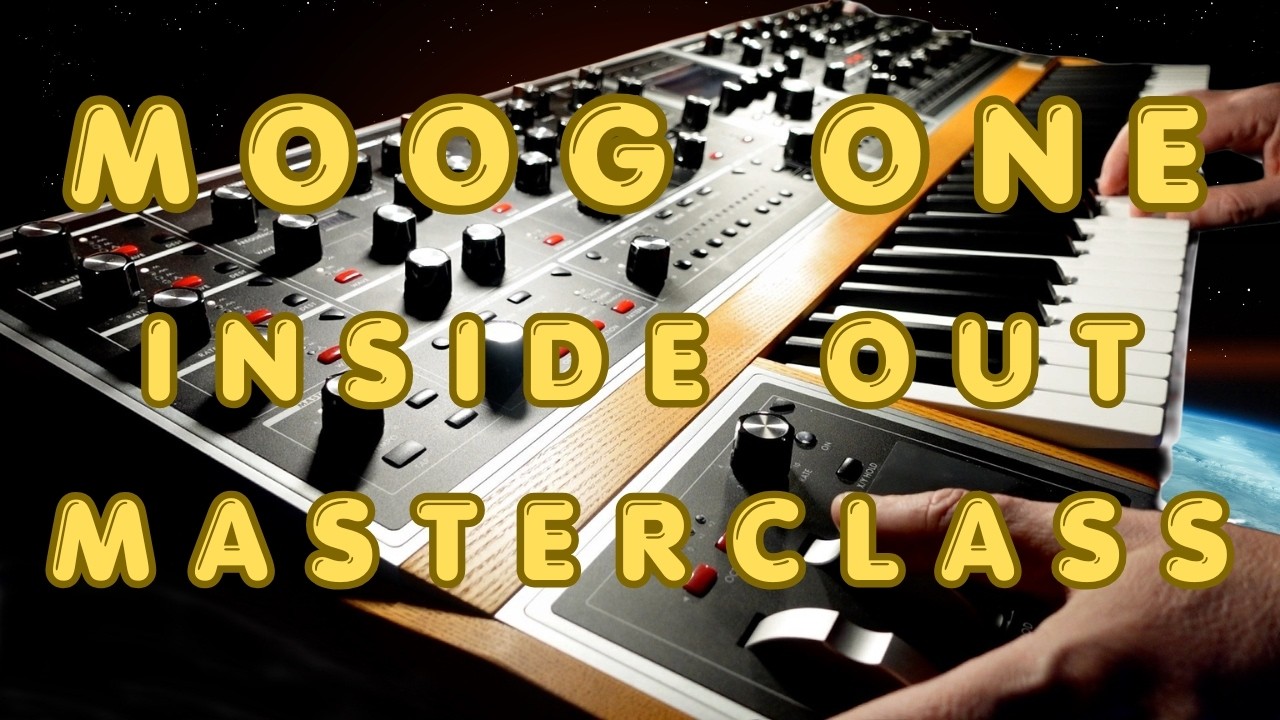
You mentioned just acquiring your Moog One earlier this year. You might enjoy checking out the series of Moog One in depth videos that @smv just released. The first one is free, and at 20 euros the entire series is ridiculously cheap. I’ve watched the second and eighth and will work my way through the others soon. It really helps to be sitting at your synth while watching.
Ok, I watched the video and he is modulating the PW with an oscillator. So it is at audio rate. I don’t see a big need to do it ( my opinion ) . Anyway the moog one has not the possibility to set an osc as a mod source. But I had an idea, that can be a sort of workaround and I hope I will have the time to show it in a video on my YT channel
The great thing in this case is that each voice of the modulation oscillator 3 will modulate at each voice of the destination at a different speed. Sounds really rich and complex. But I guess this could be achieved in the M1 by setting the lfo to key trigger and keytracking. It’s only a bit more complicated to setup.
Yes. You got the point. It will be more complex to set up, but it can be achieved. Of course not the same exact result. But I will try. By the way, thanks for the topic
Yep, nice upload. I also applied the keytracking to the lfo speed (as mentioned above) and the results are really good. Modulation sounds very richt this way and one need much less to create more. I use the same trick on my OBX8. This way one can avoid the need to dial in a second oscillator. I often prefer this approach because it leaves more space for other things.
it can go up to 1kHz …but you can achieve atonal sounds, because it will be almost impossible to track correctly the LFO frequency. But of course, they can be used for FM mod
Yes, that’s the catch. The audio-rate LFO is useful for “effect FM” — clangorous, noisy, metallic, unstable stuff — but not really for the Memorymoog-style per-voice oscillator modulation if you want it to stay musically related across the keyboard.
For that kind of result, keytracking the LFO rate gets you closer, but it still needs careful scaling and probably works best when the modulation depth is kept moderate. Once the depth gets high, the imperfect tracking becomes part of the character — which can be great, just not the same as a real oscillator-as-source in the voice architecture.
you got the point. The Moog One has a very narrow sweet spot ( differently from other synths that can do less things but more easily ), and has to be programmed wisely. In this video, I show a replica of the factory patch 111 on the Prophet 5/10 rev 4 ( that I own ), made with the Moog One. Just 2 oscillators and no FX. To have this sound on the Prophet 10 is super easy. On the Moog one it took time
 ( my opinion ) . Anyway the moog one has not the possibility to set an osc as a mod source. But I had an idea, that can be a sort of workaround and I hope I will have the time to show it in a video on my YT channel