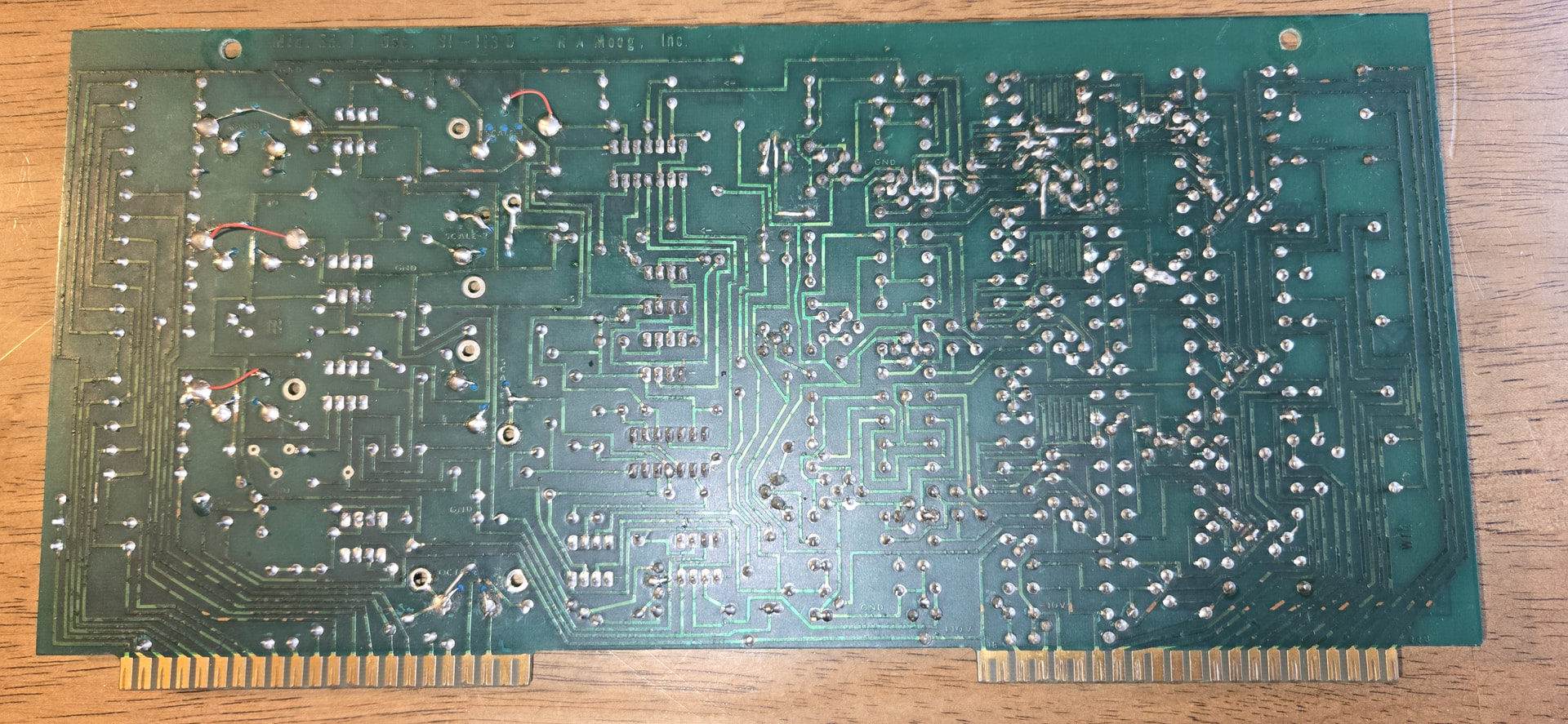
I have an old, and I mean old, Minimoog. (SN-3260). It sat in my cellar for about 10 years since I last turned it on. After replacing the bushings on the Pratt-Read keyboard, I powered it up. Oscillator 1. does not work. Nothing. BTW, it’s the OLD Osc board. R.A. Moog vintage
Does anyone know of someone reputable who can repair the oscillator board?.
Thanks in advance for any leads.
Hey There, Before I retired, and the Mini went into the cellar, I had access to a Tex 2465 scope, a freq meter and a Fluke. I do recall that I had nothing at the input to the switch. For Osc’s 2&3 the waveforms were present. That leads me back to Osc. Unfortunately, I don’t recall if I drilled into this any deeper. Either way, without access to the actual transistors and caps, I had to stop. I did try to get in touch with a reputable repair person in Alabama. Sadly, I never heard back from him so, I have to explore other options. I want to get this back to operational since it was a major part of my childhood and I miss playing it.
I am located in Germany, so I can give only remote advice. I backtraced several VCOs, so my recommendation is to look at the inner saw core of the dead VCO. If there is no saw at the core output, I recommend to replace the expo first, meaning the ua726 heated transistor pair or the 3046 transistor array, dependent on what your VCO uses. Thats why I asked.
In most cases I found dead opamps though, so the saw was present, but vanished in nirwana somewhere. But to identify the dead component you must trace the saw (if there is one) to the mixer stage.
Some information has been posted that is incorrect. There actually were THREE different versions of the Minimoog VCO board. The first version used only discrete transistors (it had no opamps). This design was made by R. A. Moog and only about 300 were made. The antilog function was accomplished by using a pair of matched PNP transistors.
The most common version used a CA3046 transistor array for the antilog function, this is the second version and was made by Moog Music.
There was a third version that used a ua726 temperature stabilized (heated) transistor pair and also made by Moog Music.
I am posting this because the OP mentioned the oscillator board was R. A. Moog vintage. If that is true the schematic for it is very hard to find although not impossible. I have it in electronic form if anyone needs it.