Am thinking of adding extra VCOs to my home built 3C/55 but would like the security/stability of modern tuning and tracking but hopefully retaining
a good old Moog sound..anyone point me in the right direction preferably
DIY project (Ive heard the Oakley VCO are good?)
I personally would look into the Synthesizers.com VCO’s with the ultra stability upgrade. They are by far the most affordable and stable Moog clones on the market.
Thanks Voltor I will have a look at these Osc. what you say sounds promising The 3C is not a 3C yet, still have the third tier to complete so its more like a 55 at the moment with a mixture of modules from both.
The MOSLAB modules probably more closely resemble the modules than any other Moog clone that Ive seen so far. THe dotcom Oscs are loosely based on and resemble the 921 to a degree but I think have an extra waveform.
THey are a little more expensive though and I don’t know what makes the actual circuit different.
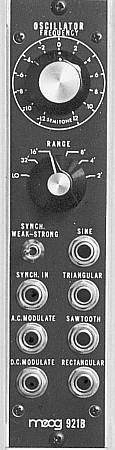
THe Modusonics, we have determined are the closest to actual original designs because they are based purely on the original designs and use original parts. THese cost around 700 though and I don’t have a picture of those, just pictures of my 921b.
Edit: I WOULD NEVER DO BUSINESS WITH MIKE BUCKI BECAUSE THERE ARE NUMEROUS INSTANCES OF CUSTOMERS NEVER GETTING THEIR EQUIPMENT BACK.
Thanks Erick…OK I’m looking for the 60’s or 70’s modular Osc sound OR early Minimoog osc sound + good tracking…votes on Oakley / .Coms / Mos-lab please!
To reiterate…Synthesizers.com oscillators do not require the oscillator drivers, and are quite affordable, and are also very stable with the stability upgrade…probably the most stable on the market.
MOS-LAB’s require a driver, which greatly adds to the cost, but retains Bob’s original design.
Modusonics are the most expensive, but are exact replicas of Bob’s design and utilize the same components as the original modulars.
Oakley’s design has a board that ultimately will be discarded. It’s an interface board for their own modulars. You’ll be paying for something you’ll never use, although their core oscillator design is similar to the .com’s. Using this information, you’ll be able to make an informed decision.
Maybe I’m mistaken but I was under the impression that while the 921B ocsillator design requires the 921A oscillator driver module (no matter who makes one: Moog, Modusonics, Mos-Lab or Club Of The Knobs etc) the straight 921 oscillator does not require the 921A oscillator driver and works stand-alone. Is this correct or not?
Just FYI for the original poster: I’ve heard great things about the Oakley VCO but it’s stability may be matched or even exceeded by the Synth Tech MOTM-300 VCO. (I have several MOTM-300’s and they are GREAT! ) But while both of those have panels that are the same height as Moog panels, they are a little narrower and the mounting hole spacing is different. Also the layout and graphics aren’t the same as the Moog style. If you want to put these into a Moog case you might want to at least get some blank panels from synthesizers.com, drill and silk screen/label them and transfer the gutz over.
Thanks chaps ..well deducing all I’m going for the .Com and see how that performs…its a shame because my home made 901b (exact replicas) sound incredibly fantastic..raw-full-fat-and primitive but musically their crap . I get them to track (just) and next day..back to square one one 901b 's octave is out by a semitone in middle C range ..talk about frustrating, got the sound cant get the music. i guess I have to experiment with with various VCO units.
Can anyone please explain why there are two different Moog VCO “types”? Was the 921A+921B(s) just a more economical solution than having a bunch of 921s or?
Will a 921 and 921A+921B pair sound pretty much the same or are they completley different?
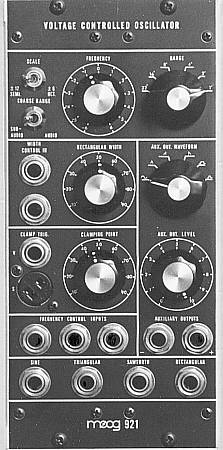
A 921 basically IS a 921A with a 921B together.
The boards to both the A & B modules are contained in the 921.
There’s no difference in the sound between the two configurations.
The larger 921 has a mixed bi-polar output that’s a bit hotter than a 921B delivers and the sync has some minor changes between the two, but otherwise they’re pretty much the same.
and to continue…the 921A can drive 3… 921Bs if I’m not mistaken correct me if I’m wrong so its a matter of real estate. The 921B frequency range is 1 to 40,000 hz. The 921 has a frequency range from .01 to 40,000 hz really a super LFO that also does the audio range. A unique feature of the 921 is waveform clamping at any point in the cycle…by S and V trigger signals.
I’m not sure if these are Synth.com specs or Moog, but if Moog, they’re not absolute gospel.
For example, a 921B can go as slow as a 921.
Just give it some negative voltage.
I’ve measured their top frequency and 50-55Khz is common.
I’m pretty sure a 921B can go slower than 1hz when set to LO too.
A 921 is a much better LFO than a 921B though simply because it’s not paired with additional VCOs, it has inversion and there’s an output volume control.
I’ve also had a 921A drive six 921B’s before, fwiw.
Great info, as always Kevin! This discussion is most helpful to someone who would like to enter the world of modular synthesis, but who has no real understanding of it. Thanks everyone!
the 921B has a frequency range from 1-40,000hz
the 921 has a frequency range of .01 to 40,000hz
921b
AC and DC coupled frequency control imput jacks-linear responce
921
3 frequency control input jacks-exponential responce
Kevin,
Im not contesting you, im just quoting what the literature says.
If you want to think about it, generally, I was told by Mike Bucki who built my Modusonics 921a that it will drive 3 921b’s. Now Im sure with a harness it will probably drive more like Kevin said. But generally you see a 921a driving 2 921b’s(system 15/35) or 3 921b’s (55).
So a system 55 will have generally 2 921a’s and 6 921B’s taking up a total of 8 spaces in a cabinet. In a portable cabinet thats an entire row…very space consuming to have the extra voices.
6 921 modules will take up 12 spaces. (2 space width each) So from the side of my mouth I will say that a bank of 921A/B combo provided more voices per space than a pure, fully loaded 921 module in a complete synthesizer setup and thus was the reason for the option.
From Modusonics from april 07 prices, a 921a was 425 dollars, 15 shipping. THe 921B is 685 dollars with 15 shipping. (of orded on an individual basis. A desktop power supply would be 100 bucks.
THe 921 module costs 1285 dollars plus 15 shipping and 100 for a power supply if you don’t have one already.
So It is a little cheaper to go the 921AB route as it probably was in the 70’s.



 ) But while both of those have panels that are the same height as Moog panels, they are a little narrower and the mounting hole spacing is different. Also the layout and graphics aren’t the same as the Moog style. If you want to put these into a Moog case you might want to at least get some blank panels from
  ..well deducing all I’m going for the .Com and see how that performs…its a shame because my home made 901b (exact replicas) sound incredibly fantastic..raw-full-fat-and primitive but musically their crap . I get them to track (just) and next day..back to square one
  one 901b 's octave is out by a semitone in middle C range
  ..talk about frustrating, got the sound cant get the music.
  i guess I have to experiment with with various VCO units.