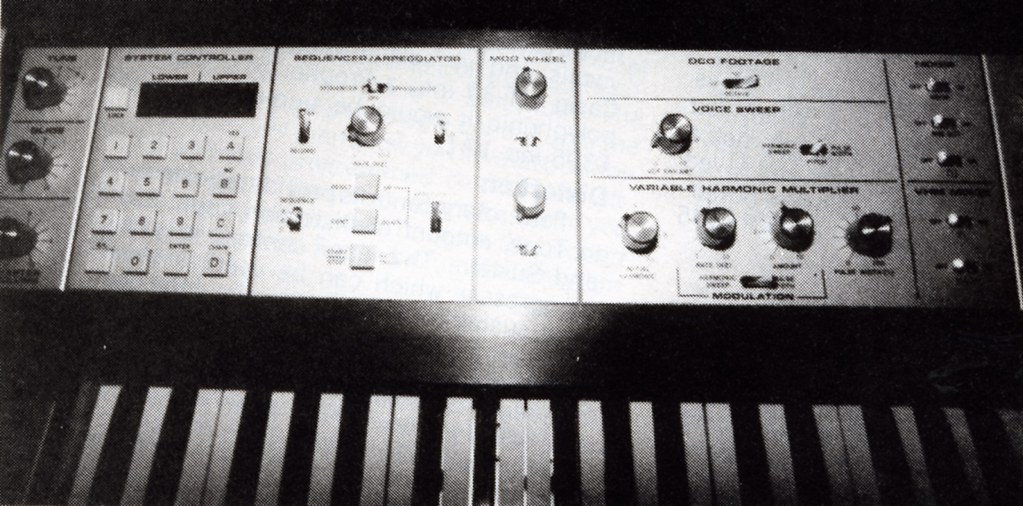
How many of you would like the new Moog Music to resume development of the SL-8 synthesizer, possibly turning it into the SL-16. But, despite a 16-bit microprocessor, this was to be a lower-cost alternative to the Memorymoog, so would the SL-8 be that much better than the Memorymoog Plus? I’d think not.
The SL-8, at the time of development, was to be intended as Moog’s foil to Roland’s Juno 60, Sequential Circuits’ Prophet 600 and Korg’s PolySix polysynths. It was to feature the Texas Instruments TMS9995 16-bit microprocessor, although I would’ve liked to know how that chip would’ve worked.
Did the failure of the SL-8 making it past the prototype stage really kill off the original Moog Music?
Almost nobody has heard it.
The innards of the prototype are gone.
Schematics are non-existent.
The firmware source code is gone.
Since we don’t know what it sounds like, the question of a reissue is a hard one. It was an eight voice DCO-based synth with one DCO, moog filter and VCA per voice. The DCO had hard sync and PWM which gave it some animation and timbre variation. The fact it had a chorus tacked on it hints at its lack of bigness. This would be starting from square one, and if the end product was thin enough that it needed a chorus then is this effort worthwhile?
The SL-8 wasn’t designed to compete with FM - totally different synthesis. At the time the DX-7 was in demand because it had good organ and EP sounds which appealed to musicians who wanted instant gratification with no tweaking and would stay in tune. Back then the SL-8 offered new synthesis but musicians were tired of tweaking. Remember back in 1983 piano players and organists did not have any portable alternatives, and they weren’t too intrigued about tweaking Prophet-5s and Oberheims that didn’t have velocity sensitive keyboards and kept drifting out of tune. The DX-7 met that need.
Don’t forget how amazing it was to hear higher frequencies being controlled by something other
than a LowPass filter. And the never-before-heard Brass and Sax articulations via the Breath
Controller. And the Synth String Pads, and Metallic Basses, and the patches that could say
the numbers from 1 to 10… Exciting times they were.
The technical facilities of the DX7 are astounding, and it’s a very impressive synth qua synth. But as a musical instrument, it’s nothing but a nice preset board since on the fly manipulation is such an awful hassle
Were I more of a keyboardist, I’d play mine a lot more, but as a synthesist it leaves nothing to do but dawdle over programming at the start of every session if I want a new sound, and then simply pressing buttons to jump from one patch to the next.
Playing it definitely feels a hell of a lot more like being on the bridge with Captain Picard than the Polysix or the Moogerfoogers do
“It was an eight voice DCO-based synth with one DCO, moog filter and VCA per voice. The DCO had hard sync and PWM which gave it some animation and timbre variation.”
How do you get ‘sync’ with a single DCO? Maybe it was a dual DCO design??
“But as an instrument it’s nothing but a nice preset board.” Wow, what a different
view of such incredibly musical synthesis power. On-the-fly-manipulation occurs
via PitchBend, ModWheel, Velocity, Aftertouch, Breath Controller, Foot Controller,
and various CC#s; all of which could warp a sound into something entirely new.
And the best part was that everything that was produced in between the Min
and Max of all the above controllers could be swept in musically useful ways
that had never been heard before. For a few years, in the mid-'80s, all of the
synthesis I performed live was on a DX-7, TX816, and a TX81Z.
I get that FM synthesis and the DX-7 may have been a partial mystery to you,
and that the actual playing of the keys is not your forte, but to declare it:
“nothing but a nice preset board” is still an odd generalization for such an
exquisitely expressive and musical synthesis instrument.
How to do 64 or 128 analog filters for such a number of voices so that we don’t have to sell our home to buy it?
There are not many synths with more then 16 analog lowpass filters.
Yeah, I’ve made some wild patches on it, but unlike a subtractive synth there’s not any way to usefully morph from one sound to another, it’s all gotta be preprogrammed. Preset probly wasn’t the right word to use, but once you select a patch you can’t change anything about it that you hadn’t programmed before. That’s what’s so limiting for me – it’s making patches then playing them instead of making patches while playing them