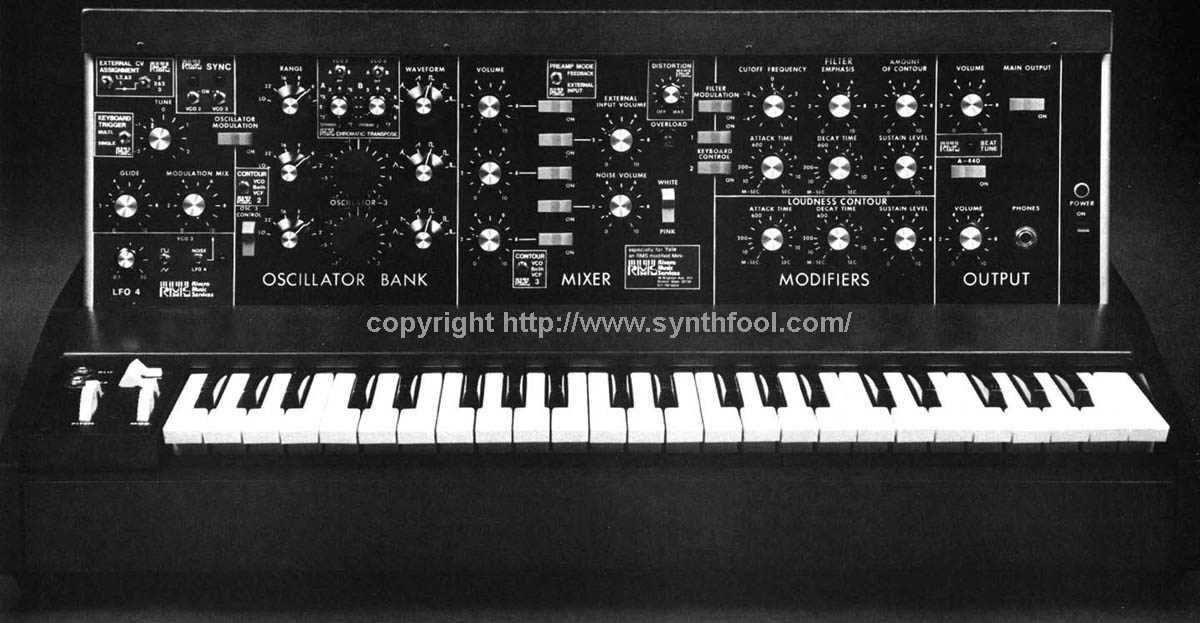
I am relatively new to the synth world and came to know about synthesizers only about three years ago. Since then I have purchased a Sub 37, two Mother 32’s and now a Model D reissue. I love all of them and even though I promised myself I would not end up with more than one or two synths here I sit with four of them.
Anyway I have heard of people having certain modifications done to their older Model D’s, things like oscillator sync and others I cant think of right now. I am wondering what the pros and cons are with having any of these done and what the most popular mods have been. Also IF someone were to have them done who are the best and most reliable people doing this kind of thing? Obviously I know that doing any mod would void an existing warrantee. Mostly I am just curious.
Thanks for all the replies in advance.
I would also like to suggest running the model D output into the sub 37’s input giving access to the sub 37’s darker filter and extra mod buses and overdrive. It just sounds exquisite as another sonic option.
I haven’t spent much time with the new Model D, but I spent a WHOLE lot of time helping my late husband restore the old ones.
I would not mod a new Model D. If you think about it, it is a modified old Mini. They didn’t have aftertouch or an extra LFO nor MIDI. Those are mods people used to do. Well, not the aftertouch. That was not possible with the keybeds used on the old ones.
Thanks for the reply. I am not so much looking at doing a mod just now as just looking into what mods are or were the most popular and who is reliable to do do them. In fact I would really like to know or see a list of reliable skilled technicians as at some point my new Model D is going to need tuning.
There are a zillion mods for the original vintage Ds but hardly any of them are worth the effort and the resultant drop in resale value. If I buy a vintage D for a restoration project I don’t want one that’s been hacked about.
You can tune your reissued Minimoog yourself if have a decent voltmeter. It shouldn’t need tuning any time soon either unless you live in an extreme climate.
We’re talking about v/oct tracking here, not simply tuning the instrument to a given note.
You can do it by ear, and I have, but it’s a hell of a lot easier following the calibration instructions that Moog provide in their service manuals, and that generally requires the use of a precision volt-meter.
As opposed to modding the reissue, I would consider getting a couple of oscillators from AJH Synth http://www.ajhsynth.com/VCO.html and run them into the external input of the Model D. It would be a lot of fun to have the extra sound sources and modulation options, and would also be cheaper in the short run (in the long run, it might lead you down the Eurorack black hole!).
I am a little new to synthesis or else a slow learner. Tell me what effects that would have. Also I have two mother 32’s so i could probably start quickly…
Hard sync can be done externally, you can easily use the pitch, velocity and aftertouch outputs to drive the waveform of an external module whose output goes back into the D on the audio input.
You can even drive it using the D’s output, since you have the Low/high/headphones out to tune/drive/detune it/waveform deform it before it goes back as an audio input.
seems quite inspiring, if you have the gadgets. if you don’t, you can always try doing it with your soundcard/computer or maybe an OP-1!
Kevin certainly was master in moogs, good to hear his interest has been spread to his relatives too , thank you very much for charing and keep doing so please
I think with patience a good hearing and experience tuning could be done without metering ( my pianotuning man does it all day). For the most of us fortunately a tunerdevice is invented
Yes, it is just about possible to tune a Moog by ear, but it is very much easier with a precision voltmeter. We’re talking about v/oct tracking here, not tuning an oscillator to a particular pitch.
Slightly OT, but it is easier to adjust the trimmer for the volume on the Voyager by ear than using a voltmeter/oscilloscope
The output should simply begin to lower the volume as soon as you begin to turn it down, and it should go completely silent just before you hit the zero value