Hello again friends.
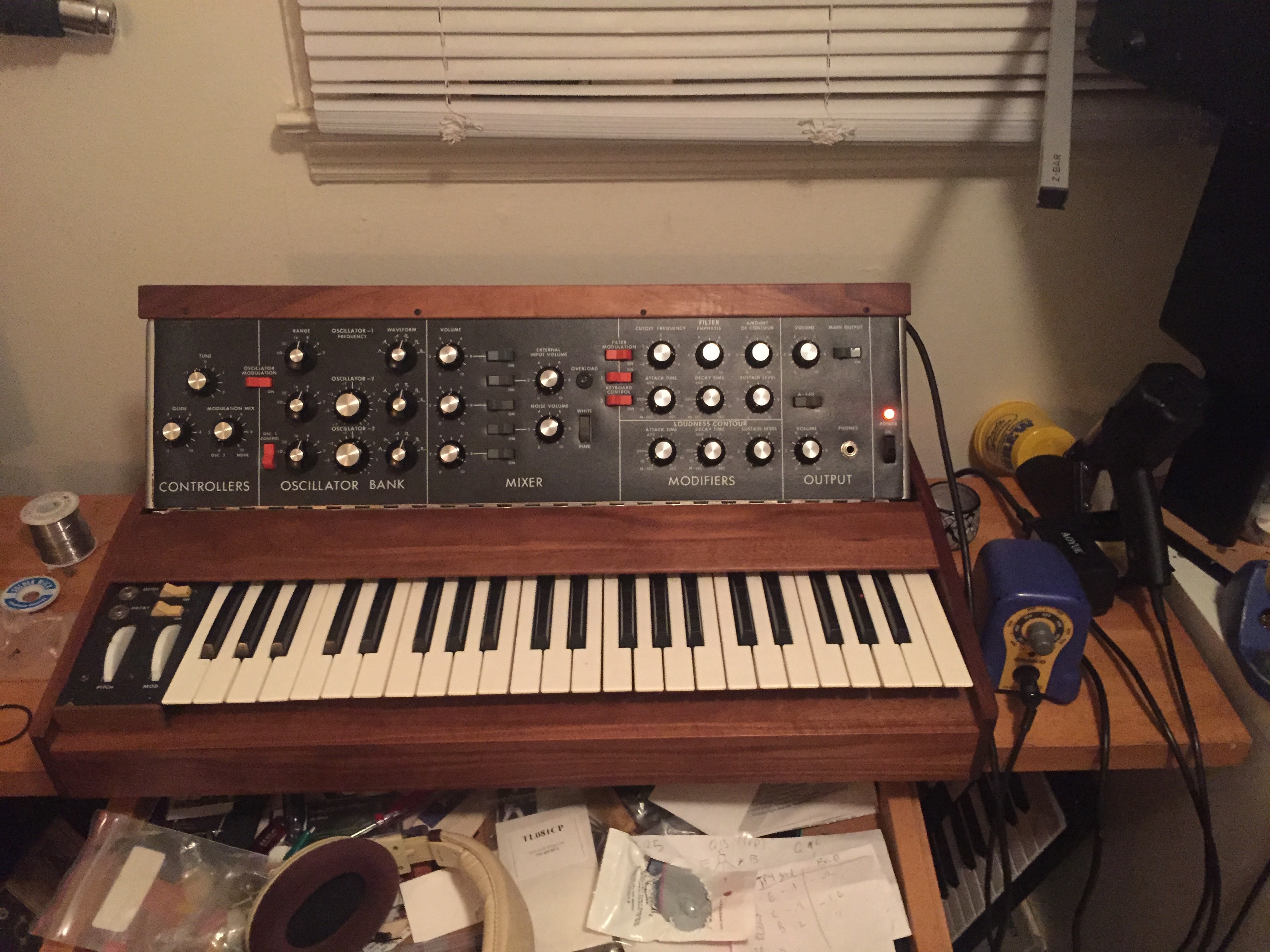
I scored a minimoog. I’ve been looking at these things since the 90’s. This is a big deal to me.
It was in pieces in a basement. I was buying other things from the owner of said mini, he didn’t even really mention the thing. I couldn’t stop thinking about the mini, and called the owner to work out a deal. He gave me an extremely reasonable offer, but still more than I could afford. The next day, boom, like a bolt of money lightning from the sky, I get the word that a wurlitzer 140b I rebuilt on spec some time ago was to be bought by a big studio here in town. Half the money appeared. Not 12 hours after this first windfall a friend bought a keyboard from me I’d been trying to sell. There was the rest of the money. I ran screaming (internally anyway) to guys house and made the deal.
Huzzah
It is a 1974 that was sent back to the factory for the new osc board and octave buffer. At some point hobbyist mcghee did a pretty bad electrolytic cap job on it, but they work. I have worked out all the issues with it with the exception of the Osc 3 control switch. It boosts the frequency of osc 3 to a huge degree when in the off position. This is obviously the opposite of the expected result. When you have the range set to LO the triangle waveform looks like it is at about the '8 setting. I think it may be the osc summer, but not totally sure.
The edge cards are clean and make good contact. Switching the osc 3 control flips one voltage between -10 and -5, and connects the 7.5v line. Seems to be wired up properly. Does anybody have any suggestions. Once again, this is the new oscillator board.
Model Ds are now so ancient and generally hacked around by clueless DIYers that anything is possible. The only way you’ll get to the bottom of this is with a lot of patience and a good meter and 'scope. A while ago I did a Model D restoration for a former band-mate (he’s a great player but completely clueless about electronics). The thing was a wreck. Hundreds of hours of my life I’ll never get back. I even sanded down and re-varnished the woodwork - it looked mint. The worst thing was he sold in on almost immediately and got a Voyager with the proceeds.
Make sure you replace all the electrolytic caps even if you think they are working. Check the voltages at points 9A, 10A, 11A and 15A on the osc board. Check that transistors Q3 and Q19 are functioning properly. Good luck!
Doing this might be regretted later… I did just that on one of my Mini’s and it never did sound the same again.
Always replace the electrolytics in the power supply, yes… but all the others I would leave… unless they are obviously leaking. It can really make a ‘Great’ sounding synth sound just ‘OK’.
Hey there, Thanks for the replies! I sorted it out. My problem was twofold
Fold the first ) The guy I bought it from said that this was an issue, and I believed him. I am a trusting person by nature. This preconception of malfunction followed me to…
Fold the second) I’ve never messed around with a real mini before. My weed ravaged brain read the service manual incorrectly and I thought flipping the osc control should lower the frequency of the oscillator. What it in fact does is expand the range of osc 3 frequency control, amongst other things. So I was expecting a drop in frequency when I hit the switch, but was met with a jump due to the change in behavior of the osc 3 control AND the fact that the mini applies it’s own CV to the osc when control is off. So I convinced myself I had a problem where there was none, and set fire to several hours. Oh well. I learned a lot about how the oscillators work during the process, and that is valuable knowledge. I also learned for the millionth time to pay closer attention to technical documents.
other than osc 2 making occasional coughing sounds the mini is done. I put it in its case last night. Here’s a pic.
for some reason this pic is upside down, if you click on it everything works out ok, though.
Good point Tom. As they age electrolytics can add noise which can add character to the sound. Personally I would replace them but your point is a very valid one. The one I restored sounded awful so there wasn’t much sonic character to lose.
Yeah. My reaction exactly - worse he didn’t let me know he’d sold it until showed up at a rehearsal with a spanky new Voyager. I would have bought it off him. He did pay me a good amount for the restoration work so I guess it was his business. Even so
Hey Stevie. Yes, I was aware that the osc control switch decouples the keyboard cv from the osc, I just was just surprised by the behavior of this action. Also, as I mentioned before, I misread the portion of the service manual pertaining to the control, so I was expecting it to do something that it does not. You can wait on that sort of thing all day.
The coughing noises were one half of a 393 op amp going a little funny in osc two. The cough only happened on the pulse waves, I isolated it with a scope and changed it out. It was fun seeing the wave freak out on the scope. I figured that was the problem from the first time I looked at the schematic, so I ordered the parts from mouser last week. At the time the coughing was the least major problem with the mini. So, as of this afternoon, this is a 100% working mini, resurrected from from the grave. #4714 is back in the game!!!
All what I know is VICE VERSA. Ive always heared through the years the caps in the PSU should NEVER be changed, as theyd have a influence to the sound (???)
Not at all… the electrolytics everywhere else in the synth would be more likely to “change the sound”…!
Granted, really badly performing, faulty or out of spec power supply caps can change everything - analogue synths absolutely rely on “perfect voltages” - but to fix that you would change them..!
Megavoice – replacing ageing electrolytic caps in the power supply can only be a good thing. As others have noted above, replacing caps in the audio signal path can affect the the sound and character of the instrument so that’s up to you. Personally, I replace ALL electrolytic caps and I’ve only ever noticed an improvement in audio quality and noise levels after doing this. Replacing the electrolytic caps in an ageing PSU is the first thing you should do in any restoration project IMO.
Thanks for the info.
I already know all this, and years ago when my Chroma didn`t work any more properly the first my former tech advised me was, to do a complete cap Job at first, and my very first question after was if there would be any risk of sound changing, but he denied immediately.
So I let him do the Job and the Chroma still sounded as “dusty” and “dirty” like before.
But once he told me as for the Minimoog, and I cannot reproduce what he told me as Im no tech, people complained about the sound after having done the cap job on the PSU. So he never did and with a great exception in comparison to all other vintage synths he still rejects doing any alterations on any Minis PSU, even NOT replacing it in total.
Well into its production in the 1970s, they re-designed the power supply to make it cleaner and when it was installed it caused the VCOs to lock together. You NEVER want VCOs to lock together as this ruins the sweeping effect of multiple detuned VCOs. It turns out that the original power supply had just enough noise on the power rails that it prevented the VCOs from locking together. If you re-cap, you risk making the rails too clean and the VCOs will lock.
Imperfections can sometimes be a good thing. Turns out this is also true with the old Moog modulars. I almost did a re-cap on my RA Minimoog until I uncovered this “imperfection”.
Minimoog is one of the rare exceptions though. In general a re-cap is a very good idea on any analog synth.
If you replace the original caps with the exact same values nothing should change, since the circuits were originally designed with caps of those values (imperfections and all).
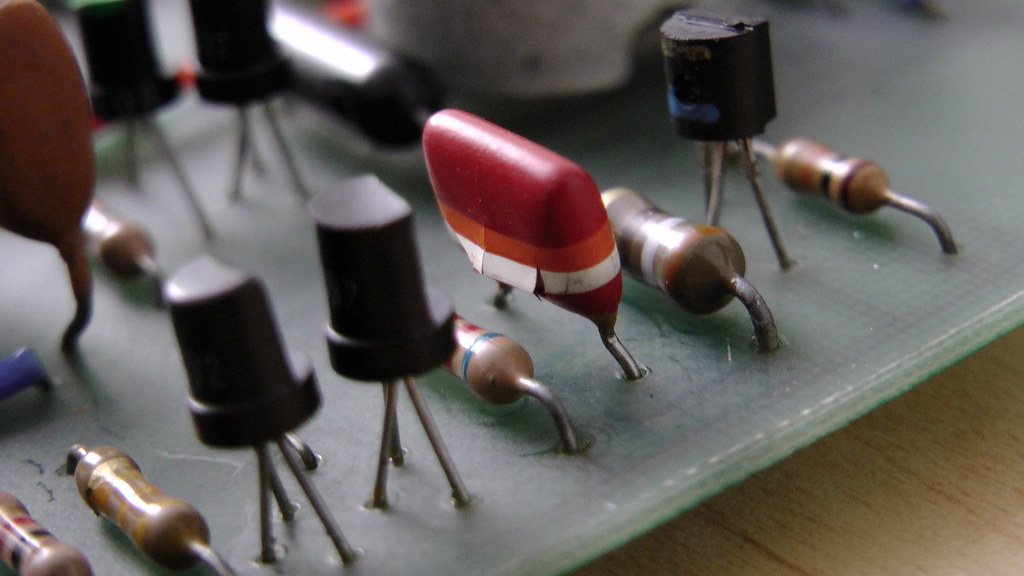
BTW, unless your Mini was left/used in a harsh environment (very hot) those high quality japanese (Matsushita) electrolytics capacitors will probably be almost as good as the day they were made. I can confirm that they are on my own Minimoog D with ESR readings still well below nominal values even over 40 years later. So I agree with MC, but not for the same reasons, no recapping needed there.
Some caps that might need replacing are some Mylar ones (with color stripes) on which the external coating is cracking and delaminating. But even those still show correct values (both ESR and capacity), and the Mighty Mini is still working fine despite those.