So I ordered a dotcom cable for the S-trig. When I plug it in the input, the envelopes open, but there is no release.
I plug the S-trig into the input and one of two things happen. Either it has the same effect as the bypass switch being in the on position, or it is silent until I insert the other end of the s-trig plug to any jack such as a multiple with no voltage present.
If I wiggle the cable near the CJ plug but not the plug it will go silent. If I wiggle the plug but not the cable it will go silent.
The small prong of the CJ is going to the sleeve of the jack and I get continuity when tested. The fat prong I can only assume is going to the tip and I don’t get any continuity there.
I have used the S-trig once before with the 1130 percussion controller with no problems.
Do you guys think it’s the jack?
I was surely looking forward to slaving the Micro to the Voyager for some unison goodness.
S-trig is short for “shorting trigger” IE a short to ground triggers the EG.
There are different ways to build S-trig outputs. The simplest is a mechanical switch in which both leads in the cable are required. The other and more common is a transistor that causes current to flow to ground (which is a short to ground) when active. The “gotcha” is the transistor can only conduct current in one polarity.
Likewise with S-trig input circuits… some designs need both leads in the cable to work, others don’t. Some designs need ground current in a certain polarity.
If you get the wrong mix of output/input circuits with an open on one of the leads in the cable, that can cause such a malfunction. You can simply re-connect the open lead and try again without worry of damage.
If it still doesn’t work, another quick and dirty test is to simply short tip and ground on the cable with a metal paper clip, which is a mechanical switch. If that works, then the current polarity between output and input circuits doesn’t match.
An S-trig is a switch or short (to ground) trigger.
If there’s a short, it will trigger and not release. Just like bypass.
Continuity checking assumes the cable is wired straight through.
But most converter cables have a transistor inside.
(Voltage from a V gate are applied to the transistor, which shorts and becomes an S-trig.)
With no voltage on 1/4" side of converter cable, it shouldn’t cause an s-trig.
You didn’t say if the cable otherwise works with voltage.
Cinch jacks can become corroded, stopping an s-trig from working.
I’ve also seen (documented) build issues with some dot.com stuff before.
Quick test on most s-trig converter cables: use 9v battery on 1/4" plug. S-trig should short on cinch.
Ohm meter can verify if s-trig is being produced too.
It sounds to me like the wires inside the CJ jack on the dot.com cable might be shorting. With the new cable completely disconnected, try testing for continuity between the prongs on the CJ connector while wiggling the cable where it enters the CJ end. As has been said, shorting the CJ jack is what triggers the S-trig.
Just inserting the cable into the CJ input will fire the envelope once. Inserting the 1/4th plug into any jack, be it an unused multiple or a gate output that is firing will have no result.
Because you guys know I don’t know anything about electronics, let me tell you exactly what I have done. I thank you for your patience.
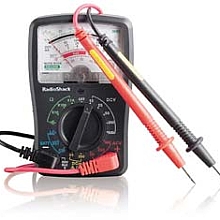
I have a radio shack 17 range analog multimeter.
On the section for Ohms I turn the dial where there is a sound indicator. Touching the leads produces a tone.
Black lead to short prong, red lead to sleeve I get a tone. Move the red lead to the tip and the needle moves.
Black lead to fat prong, red lead to either the sleeve or the tip I get no tone or movement of the needle.
Red lead to short prong, black lead to sleeve I get a tone, black lead to tip the needle jumps.
Red lead to fat prong, black lead to sleeve and tip makes the needle jump, no tone. Higher jump on the sleeve.
This is the procedure that I have done and the results.
Is this how a properly wired S-trig cable should behave?
OK, so as Kevin said, with no voltage on the 1/4" connector, you should get no continuity tone from your Ohmmeter when the leads are connected to the CJ prongs. So your first test was good.
On that second test, if the signal from your triggering source was over about 2 volts, you should have gotten the continuity tone from your Ohmmeter when the leads are connected to the CJ prongs.
I liked Kevin’s suggestion of using a 9V battery between the tip and the sleeve of the 1/4" connector, while testing for continuity with your Ohmmeter when the leads are connected to the CJ prongs.
On that, the red probe to the small prong, black to the fat prong, with the battery, it acted like it wanted to produce a tone but it was very faint, almost like it sounded more like the needle moving rather than the loud tone it produces when you touch the probes together.
I might have missed it but did you say that doing a low-budget short (wire in both conductors of CJ plug) achieves the desired effect?
This is definitely the first thing to confirm as it will confirm proper operation of your Micro. You should be able to just take a piece of stripped wire or a paperclip (delicately! don’t mangle the Micro) and see that closing the circuit fires the envelopes as it should.
If it doesn’t do that, forget about anything else.
I’m guessing that your sequencer etc. all work well because you’ve been patching stuff up for ages.
The next step is simply that the circuit within that cable (which is faulty?) is acting on the voltage as it should. And since it’s Roger’s cable, I would have to think that if he is doing a thorough job that the values are such that it works properly with a q119.
Shouldn’t be more than that? (easy for me to come along at this late date and say all of the above). But seriously, very interested if the first thing works properly.
Forgetting about “the” cable, what happens when you insert either a switched sustain pedal with the proper CJ jack head, or use a stripped wire or piece of unshielded wire/paper clip?
What are you trying to trigger the micro with? When I hook it up to my voyager I have to put the voyager trigger into the cp mixer and either amp it up or offset it I don’t remember. But if I didn’t I would trigger the micro and leave the gate open.
NewCable:
1.Black lead to short prong, red lead to sleeve = tone.
2.Black lead to fat prong, red lead to either the sleeve or the tip = no tone or movement.
3.Red lead to short prong, black lead to sleeve = tone
4.Red lead to fat prong, black lead to sleeve and tip =no movement on sleeve, more on tip.
5.Black lead to short prong, red lead to fat prong=no movement no tone.
6.At trigger source: Black lead to short prong, red lead to fat prong. Needle Pulses with gate
7.Red Lead to short, Black to fat, 9V battery to tip and sleeve= tone
8.Red lead to fat prong, black to short 9v Batter to tip and sleeve=needle, no tone
9. Red to sleeve, black to tip when inserted in Micromoog will fire repeatedly at my will.
Old Cable:
1.Black lead to short prong, red lead to sleeve = tone
2.Black lead to fat prong, red lead to either the sleeve or the tip = slight movement on sleeve and tip
3.Red lead to short prong, black lead to sleeve = tone
4.Red lead to fat prong, black lead to sleeve and tip = lots of movement at sleeve, slight at tip.
5.Black lead to short prong, red lead to fat prong=lots of movement no tone
6.At trigger source: Black lead to short prong, red lead to fat prong= needle pulses with the gate
7.Red to short, black to fat, 9v Battery to tip and sleeve= needle moved before battery was applied, almost a tone when applied.
8.Red Fat Black Short, 9v Battery to tip and sleeve, Needle jumped before and after battery was applied
9. Multimeter leads will not fire MicroMoog envelopes in any configuration when the old cable is inserted.
First test, cables performed exactly alike.
Cables differed
Cables alike.
Cables differed
cables differed
Cables alike
Cables differed
8.Cables alike.
Cables Different.
I am using the q119 gate out for these tests, but tries the midi-cv converter and the Voyager’s gate out, even sent to the mixer and amped up, and then sent to a mult and both to the mixer and no change in the result.
WHen plugged into the Micro, the old cable will always open the envelope.
THe new cable will not, and when touched to a sleeve of another jack plugged into a multiple repeatedly, it will fire and release repeatedly.