MF101 - modification for separate audio signal to env.fol.

Hi everyone,

Sorry about the delay in getting this info up - I promised it several weeks ago.

The question was how to modify an MF101 to accept a second audio signal in to the envelope follower, so that the filtering of the main signal can be enveloped by a second audio signal.

I did this to my MF101 about 10 years ago, after sending a couple of e-mails to Big Briar, and receiving answers from Bob Moog himself with explicit directions. I no longer have the computer on which the e-mails were received, and I have no backups from that time. So the following is retyped from printouts of the e-mails. Points to note:

  • these instructions apply to a Big Briar MF101, vintage 1999. I have no idea whether the board and circuit of the current version of the MF101 are the same.
  • I haven’t got around to taking photos of the guts of mine - sorry…
  • these directions are provided under the motto “no responsibility taken” - if you wreck your MF101, that’s your problem :slight_smile:
  • BUT I know that the instructions work - my MF101 has been doing this happily since 2000, when I made the modification.

First e-mail from Bob Moog, 2 March 2000:
“If you’re adept at desoldering resistors on circuit board with plated-through holes, you can lift the end of R5 and connect your external signal to it. If you have access to shop equipment, you can drill an extra hole on the back panel of the MF-101, mount a bridging jack in that hole, and then wire the jack up to the R5 part of the circuit.”

Several months later, when I finally got around to doing this, I asked for more explicit instructions:
Second e-mail from Bob Moog, 5th October 2000:
“1. DO NOT REMOVE THE CIRCUIT BOARD. Remove the bottom panel and face the jacks away from you. Identify U2 (LM324A).
2. Immediately to the left of U2, starting at the top, are a) two diodes, b) a 270K resistor, c) a 100K resistor, and d) four more resistors. That 100K, right below the 270K, is R5.
3. Carefully unsolder the left end of R5, that is, the end away from U2. Apply your signal to that end of the resistor.”

So that’s it, folks. It’s actually quite easy, and it works like a charm. Like everyone else on this forum, I’m eternally indebted to Bob Moog (may he rest in peace) for his generosity and willingness to help - as well as for the great instruments!

So, have fun!

Cheers,

Jim F.
Very cool, I’ll have to see if it works on mine!

Great mod!

SO it would function as the original if you multiplied your audio signal and sent it tothe mod and the audio in?

Interesting.

Thanks for posting!

I think that it functions as normal when nothing is plugged into the new Key In.. I have/had a few filters with this option and this is how they functioned, and iirc JimF confirmed the same operation of his in the original thread.

Hopefully JimF or someone else with some actual circuit knowledge can confirm.

That is the reason for the shorting jack in the second email. With nothing plugged in, the resistor is back in circuit.

Wow that’s seems pretty easy actually. I don’t have the equipment for drilling a new jack hole. And my soldering skills are moderate at best. But I will take it to my tech and have him check it out.

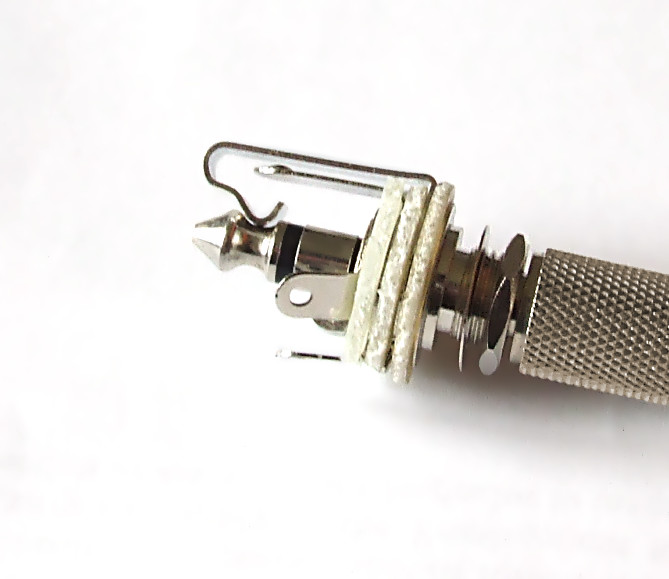
Bob called it a “bridging” jack in his email, but it is also referred to as a “half normal” jack. Plugging a cable in lifts the “normal” connection. Unplugging the cable lets the metal bend back and make the internal connection. You’ll need to use one of these to have it work that way.

Thanks for sharing this great mod. I had thought about making this type of change to my MF-101 back in 2006 to interface it with my Nord Modular G2X, but I came up with a different solution:

http://electro-music.com/forum/topic-12266.html

Too bad this mod separates the Level LED from the filter audio input, but that’s a relatively small price to pay for greater functionality.

I don’t know what Revision of circuit board Jim had in 2000, but the Rev. D board in
my recently purchased MF-101 is significantly different.

Can anyone definitively say what the new part ID is for that same resistor on a Rev. D
circuit board? (I’m not sure that it’s R5 anymore.) And which end should I lift?

I would recommend contacting the Moog guys then.

My MF-101 board is marked P/N 11-350C and is layed out as described by Bob. The 100K R5 is connected to pin 3 of U2. The resistor leg not connected to U2 is the one to lift. But, on the D board, U2 might not be the same circuit design…

I think this has already been brought up, but this mod would be great for the mf-107 too. Has anyone attempted such a thing?

Yes :slight_smile:

It’s very cool, the signal at the audio input still interacts with the oscillator (FM, sync and envelope), while the CV signal controls the VCA. Immediately many more things become possible to do with the FB. You can even use the raw oscillator directly and have an ADSR envelope shaping the VCA; a real 'fooger synth!

That’s even better, exactly what I wanted actually.
Can you share the details of this mod?
Did you do it, or was it a factory mod?

Hi there,

I performed the mod myself. It requires just a few parts but will involve cutting a trace on the PCB. I got sent some directions, but “modified” :slight_smile: them slightly to what I thought was a better method.

I’m not sure if I should give out the details. One condition on receiving the 104 Spillover Mod directions was that I kept the information private. I sent “rosser” at Moog my instructions, which I’m sure he’d pass on to you. I haven’t asked, but if he says it’s okay I’ll post the directions on the forum. It isn’t too much different from the 101 mod given above.


Cheers
Andy


P.S. Happy Thanksgiving! :slight_smile:

Thanks Andy, I have one more question. Is your freqbox surface mount? I’m pretty sure mine is.

Hi there, yes, the FB is SMT. The sockets are through-hole but they used lead-free solder which made desoldering them difficult. But nothing is desoldered for the gate mod.

So I tried this mod, exactly as described, however applying signal to R5 doesn’t seem to do anything. If I send it a CV, it works.

Am I missing something? Do I need to attach a ground wire from the jack as well?

Hmmm… Applying an audio signal into R5 should work… of course, any signal input, audio or CV must have a common return. If the CV signal you send works, what is different about the audio signal that you send?

Hi there,

I’m the original poster about the MF101 (Big Briar version) mod.

I assume that the problem you’re having is with the MF101 mod, not a 107 mod. This being the case: yes, you need an audio ground path from the socket bringing in the audio signal to go to the envelope follower. If I remember correctly, this is as simple as running a wire from the ground of that socket to the ground of the main audio in socket. (Sorry, on the road at present, without MF101 to hand to check it for you.)

If you find that CV is working via the new socket (which isn’t actually the point - it’s meant for an audio signal, as the MF101 already has a cv input), then I would assume that somewhere in your setup there is a ground from whatever cv source you are using to the MF - possibly via a mixer or something, if your cv controller is a synthesizer (or theremin or whatever) with audio out going to a mixer to which the MF is also connected.

Assuming we’re talking about the MF101 mod I originally described, I assure you it does work. It’s been doing so on mine since 2001.

Please note, though, that the mod I originally described (as per instructions received directly from Bob Moog in 2000 or 2001) applies to the old (vintage?) Big Briar version of the MF101. I have no idea whether it can be applied to later versions - as I don’t possess a Moog MF101.

Good luck!

Cheers,

Jim F.