I usually just listen to my synths with headphones. I brought my Dave Smith Tetra to work today. I work at a music school. I figured it would sound good through my practice bass amp, but it sounded TERRIBLE. Surprisingly it was thin and distorted, which is what I could expect through a guitar amp. I thought a bass amp could handle it. It is a small amp though, but still a bass sounds good through it.
So 2 questions really:
How do you amplify your synths in a live situation?
How do you amplify them at home? If they’re integrated into your home studio, what’s your signal path?
I’m a living room synthesist, so I have a pair of powered studio monitors. My signal path is the L&R audio out of the synth into the A & B channel inputs of the digital recorder, with the L&R outputs of the recorder going to the monitors. It doesn’t shake the building off of its foundation (neighbors…) but it is loud enough in the stereo field, and the monitors have a very good low-end, so I’m happy.
If I gigged it (which I never will…) I would plug it into the P.A. as I would want a clean signal with a wide freq. response. But that’s just me. Many people consider their sound reinforcement system to be part of the overall instrument’s character, kind of like a Les Paul being played through a Marshall stack with a Plexi head. The stack is nothing without the 'Paul, and the 'Paul just doesn’t sound right without the stack! So, while clean works for me, others may want to play theirs through a Marshall stack, or even two since it’s stereo! (That would be awesome!!!)
All synths through a mixer. Mixer to a Peavey Combo 300. Using the crossover, all signals above 500cps are fed to a pair of 5" nearfield monitors on the top of my key rack. (At home) Live is the same to act as a monitor for me and also out through the PA. If I can ever lay hands on another Combo 300 I’ll go stereo with it all.
I also use a Leslie Combo Pre amp and feed the whole mess through a well modified Leslie 710 for effect at home and in the studio sometimes.
At home (for rehearsals with the band) i use a Roland KC-550, ireally like it’s sound and it sure can handle the low end really well. Live, most of the times directly to PA, but sometimes i bring the Roland to have better stage sound
Typically my set up I run everything into my berringer mixer. Chanel 1 goes to fx chain chanel 2 goes straight to amp. Either peavy kb 100 or roland kc 500, sometimes both. I use this set up live and at home unless im doing an open mic thing where I need to set up and break down quickly then I just use the house pa. I prefer my amps though. That way I control the volume mwahahaha
I have a pair of M-Audio BX8B powered monitors, bi-amped with a total of 130W ea. 8" woofers–5" just don’t have the juice for that Moog low end.
I route synths into a passive A/B box–1 output goes to the monitors, the other goes to my Pro Tools rig.
I think powered monitors are the way to go, especially for stereo outs.
KRK Rockits seem to be small enough, and they’re priced pretty well. I’ve never actually heard them though, so if folks on this forum say they sound terrible, I’d take that into consideration.
yeah ya need to use a keyboard amp if you’re going to expect to get any kind of decent sound out of most synths. The LP too sounds like a rusty turd going through a guitar amp, and really not much better through a bass amp.
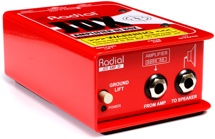
just wanted to throw in these 2 cents. certainly if we are talking about using the full spectrum of the synth (for me mg-1 or prodigy) something like a pa or roland kc550 is great, but if you want searing leads, dont forget to try running it through your favorite tube guitar amp. we got some amazing sounds on the last album by running my mg-1 through a nice fender concert on about 10.5. to make sure no damage is done to the speakers, try disconnecting the speaker from the amp and plug that cable into a direct box>interface. turns out it works amazingly well and then you can access the full potential of the tubes without killing your hearing or prompting the neighbors to calll the cops. point is, to my ears, a searing synth lead thats right on the edge of tube overdrive sounds pretty darn special
yeah guitar amps definately have their place too. i like to put my synths through my jazz chorus every now and then too with some chorus or vibrato and lots of reverb
You may want to experiment with mic’ing the speaker instead of using direct connect box, as the speaker often adds to the character of the sound of the amp.
certainly agree on miking the speaker, just mentioning that little tidbit about the direct box for those bedroom warriors or folks like me that live in stacked shoeboxes in the city. amazingly, we recorded a wurli solo half direct and half the next day with the speaker mic’d and at the end of the day, hard to tell the difference. if you care to listen its on www.myspace.com/atlruination its the track called imperial dub and during the last chorus, you will hear this phenomenon. i would love to hear anyones guess as to which half is which! also all of the bass for that band is an mg1.
I hear you! The price for that kind of “character” is blowing everyone else out of the water!
I recall reading an article years ago that said that Jerry Garcia had a specially built speaker cab that he used for recording. It enclosed the mic inside with the speaker so that he could drive the speaker to get his sound but not overpower everyone else in the studio.
Please be careful about plugging a tube (valve) amp into anything other than the speaker, as you risk the possibility of destroying the output transformer, or hurting your finals. The speaker provides a specific type of inductive load that the amp’s output circuit is designed for, and if your direct box does not present the same type of load, it can damage your amp.
That’s your idea of a joke, right? I would hope common sense prevails when people read a statement like that.
No, Virginia, you CAN NOT plug a power amp output into anything other than a properly loaded speaker cab/power soak, but if you DO, please put the video of your attempt on YouTube.
Amp power outs into a DI = (expensive) Magic Smoke.
By any chance did you use a Sequis Motherload speaker emulator DI box, or something similar? I can’t imagine your amp would’ve survived otherwise, especially cranking it just shy of “11!”
I stand by my statement. Power outs from any amp go to a proper load, period. A DI box (or anything else expecting a guitar to line level signal) is not a proper load. It is safe to say that if you don’t know what you are doing you can break things in a hurry. RTFMs and do some quick research.