Hi, I have been a member of this forum since 2004 and have owned a couple of minimoogs, and have owned other synths however briefly such as a Matrix 12 and an ARP 2600, although unfortunately I hadn’t seemed to be able to afford to keep any of these. Well, as I was looking at my Roland SH-1 synth, I realized that my keyboards would be better only after I got a minimoog. Then recently I found a Musonics Minimoog in As-Is condition. It has a key that is bulging higher up than the others, and I plan on looking at fixing (perhaps replacing) it, and the rest of the keys don’t seem to even need bushings. Anyway, there was another problem when I got it:
No sound. I thought I might be in for a long term restoration because of this. But I bought some new fuses and tried replacing them and luckily I did get sound. I tried this after noticing that the external input light did light up when an input was put into it.
Now I have a problem which hopefully I can figure out and fix without extreme expense or sending this out to a reputable tech: The #1 oscillator produces no sound. I can faintly hear the envelope and filter activate (especially if resonance is turned up) but no sound on the 1st oscillator, the other 2 do make a sound. I searched on the net for a possible solution, but haven’t yet been successful, other than a suspicion that it could be a faulty op-amp..
Does any of the resident experts have any suggestions other than having me pay hundreds of dollars to send it away and have it totally gone over?
I think it will need a calibration but the other 2 oscillators activate with the keyboard and the tracking of the keys in terms of osc freq is actually better than the 1st mini I had, which I sent away to analogics about 5 years ago.
Thanks in advance, and even if this post falls upon deaf ears I want to say any friend of the late great Bob Moog is a friend of mine, and I’ll continue to search this forum archives for info!–John C.
I offered some suggestions to John in private email.
My personal thoughts on this is that it’s a rare Musonics Mini and that it might be better to sell it as-is, take the money and buy something else that works.
It could save time, money and provide a playable synth immediately.
I want to keep it! For the same reasons… I mean, if I sold this and bought another minimoog there could very well be a worse one albeit newer, that had its own set of problems with it. And I’m happy with this one, and the challenge it provides. Anyway, this synth is playing fine. The only issue other than a simple tuning and the lifted key is the no sound on the oscillator. Thank you Kevin, your technical knowledge/input is much appreciated.
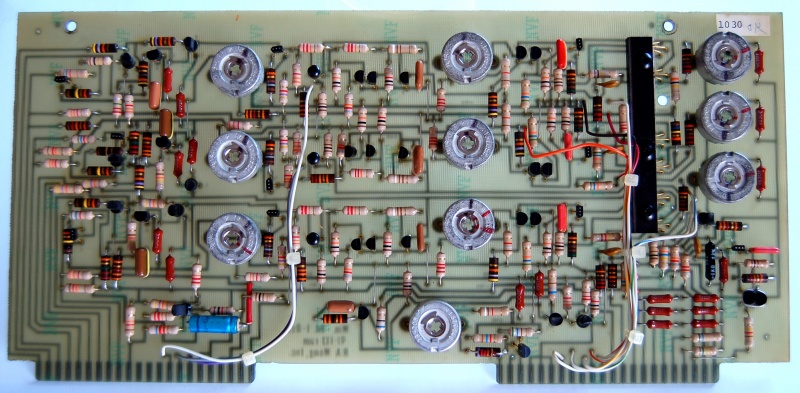
Wait a sec! When I uncrewed the top screws to the oscillator card, and moved it slightly in the plug, osc 1 came alive!! Awesome! How can I tell if this is an updated oscillator? Overall this synth is in great shape for an un-calibrated Mini. There is a crack in the case at the left side, though so I will probably carefully remove it and glue/clamp the case. I will use the original case.
Also on the backside of the oscillator it says, printed, Min. Bd. 1 Osc. 91-113 C R A Moog Inc.
Those “edge connectors” are a pain… My mini was working kinda okay, then I took it ALL apart and it didn’t work AT ALL after that… Then I sent it to Kevin, and he made it perfecto !!!
He told me that those goldplated edge connectors are VERY tricky and there is even a risky mod that you can do to eliminate them all together and hardwire the boards to the rest of the circuitry.. Yikes..
Anyway, so glad to hear Osc 1 is doing it’s thang…
It’s the 2nd one, only it says 911 C instead of D. I have consulted Kevin Lightner and as he states this will take much more than a cleaning but I am confident it will be well worth the effort.
As long as we are on the topic of ailing Minimoog Model D’s..
My little baby is starting to show her age, and there are two problems that I am noticing.
The first issue has been around for a long time–maybe for as long as I have had her…I don’t remember.
There is a “signal bleed through” of vibrato when I have Oscillator #3 set up to be a LFO. Even with the mod wheel all the way down, there is a very slight sound of vibrato. I get around this by leaving Oscillator and Filter modulation off. I think that I have seen somewhere that this is a common problem and that there is a standard modificaton for this…
The other problem is more recent–I just noticed it last week.
Oscillator #3 detunes a bit when I hold down a key, then goes back in tune when the key is released. It gives kind of a pulse wave modulation via EGR effect when the key is depressed. It is kind of a neat effect in some cases, but kind of annoying at other times.
I don’t use Oscillator #3 as a sound sourse very much, so this may have been happening long ago and I never noticed. When I added the third oscillator to a patch the other day, it was very noticable. When I changed the tuning of O#3 just a bit, it wasn’t noticable, but if I ever used O#3 as a single sound source, it would be very annoying.
I suppose that I can live with this, unless it is a signal that something else is about to blow…
Is your mixer osc 3 turned off? Is the Osc 3 modulation turned off? I seem to have that problem when I have forgot to turn a couple of other things off..
About my synth, I had to set it aside for a day or two to take care of other business. But based on the amount of time I played it prior to pulling the keyboard, I am psyched to get it back in good working shape!
The case will need to be restored. I don’t want to detract from its originality. Hopefully when I clamp and glue the crack I will be able to remove the finish and then put some type of thin clearcoat and that will be it.
The mod pot in a mini doesn’t dial IN modulation, it shorts or shunts it out.
If the mod pot, wiring, mod section connector or edge card isn’t good, it won’t reach the low ohms necessary to short it all the way out and thus it bleeds.
One can improve the grounding in a unit and do several tricks, but unfortunately I’m still looking for decent mod pots after more than a decade of searching.
For the techies, this is a log taper A pot, 50K and must have an end resistance of less than one ohm. That last spec is the hard one.
More than an ohm and noticeable mod bleedthru occurs.
One trick I’ve done to several minis is to mount a glass encapsulated reed switch across the mod pot and carefully placing a magnet glued to the side of the mod wheel.
With proper alignment, when the wheel is all the way down, the reed switch closes and shorts out the modulation. Since there’s no physical contact, no change in the feel of the mod wheel is caused.
The osc glitch can be several things, including improper transistors installed in some minis at the factory.
You’ll need a tech to sort things out more than this.
I didn’t notice this problem on my mini but I think one I had a few years ago had that problem. I heard a popping sound but it was temporary and went away when I turned the OSC 3 switch OFF on the mixer (it was because osc 3 was audible, not because of filter bleed through. Of course you’re going to have more of a pop if it is with a square or saw wave. I would think that with a triangle wave it shouldn’t ‘pop’ like it does. I’m not an expert, though.