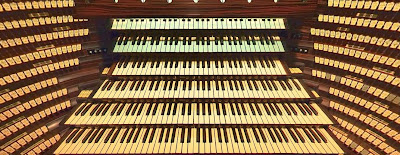
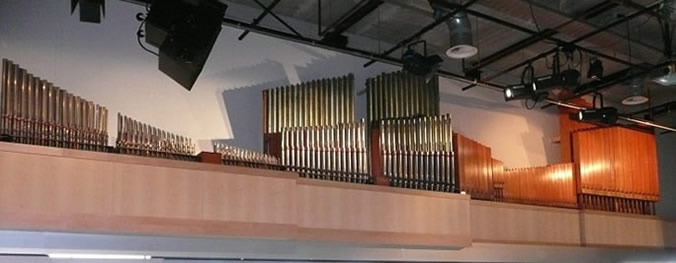
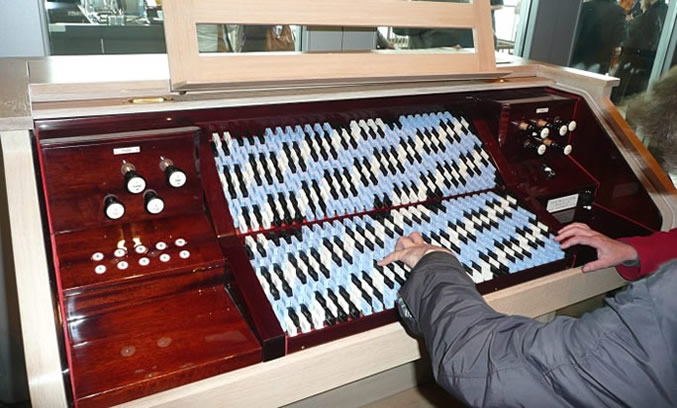
The organ’s console is the biggest in the world. It has 1,235 stop tabs controlling 587 flue stops, 265 reed stops, 35 melodic percussions, 46 non-melodic percussions, 164 couplers, 18 tremolos, and 120 swell pedal selectors for the 7 swell pedals controlling 15 swell boxes. Officially, that comes to 33,114 pipes. The console is also the only one in the world with 7 manuals, of which the lower ones have been extended to 6 and even 7 octaves, opposed to the normal 5.
The Main Auditorium is a truly vast space (488 feet long, 288 feet wide, and 137 feet high, which comes to over 15 million cubic feet of space). To fill the place with sound, Emerson Richards designed an organ with some mind-boggling and previously unheard of specifications. These include ten 32-foot stops, a 64-foot stop (one of only two in the world), 10 stops on 50-inch wind pressure (most organ pipes are about 10-inch wind pressure) and four on 100 inches (a pressure not employed in any other organ).
The 100-inch stops are: Grand Ophicleide 16-8; Tuba Imperial 8, Tuba Maxima 8-4; Trumpet Mirabilis 16-8-4. They had to be specially designed so as to not turn into projectiles when played. The loudest of these, the Ophicleide produces 130 dB at 1 metre distance. Needless to say, it is recognized by Guiness as the loudest organ stop in the world.
An experiment was carried out in the 1950s when most of the organ was working. Everything was coupled to the Great, and when played, the ice cracked in the hockey floor of the hall and the organ could be heard (and felt) outside along the boardwalk nearly 1000 feet away from the organ console.
Unfortunately, the organ has fallen into a state of disrepair over recent decades, leaving it only partially playable. The Atlantic City Convention Hall Organ Society is working hard to preserve and restore this historic instrument.
I bet it CAN play “Jump.”. That’s just breathtaking. Santa Barbara restored its theater organ (Arlington Theater) a few years ago with donations. This organ needs to be heard too.
Skilled pipe organ players can do unbelievable things. I bet that thing fully functional sounds like the voice of the gods. Thanks for sharing.
Pipe organs and their history is interesting to me. I grew up a few miles from the original Wurlitzer plant in NY. I heard from my folks that a few decades back when the plant closed for good, a lot of stuff that we might find interesting and/or valuable went into dumpsters including bubbler jukebox stuff. Unfortunately not likely any electric piano parts as those were made in Illinois.
In that case you might want to check out “All the Stops” by Craig R. Whitney. It chronicles the history of the pipe organ and the famous musicians who played it; in particular E Power Biggs and Virgil Fox.
It’s cool you supported the restoration of the organ. We have a whole theatre in my hometown (Saenger) that needs to be restored, but a lot of the community simply isn’t interested. Their organ was sold long ago.
Right on… I actually have that book! Unfortunately Wurlitzer is mentioned about 5 times and the author does nothing but mock the company and their organs. The so-called “mighty Wurlitzer”… Otherwise it’s a decent book.
I love the sound of a good pipe organ, but they are very costly to maintain, so many of them fall into disrepair. Very sad, because a fully functional one is AMAZING in the hands and feet of a skilled organist.
Exactly. I knew a guy who was a huge fan of organ music and had a $19k sound system in his cathedral ceiling living room just so he could FEEL like the organ was there. It was only an approximation of the experience, though.
Indeed. I will remember all my life the experience of listening to a Casavant 6500 Pipes Organ at Montreal’s Basilique Notre-Dame Church, when I was about 8 years old. The official organist was Pierre Grandmaison and he played some Bach. I had never heard anything as impressive before, or since then…