How is the sound before and after? Did you have to do much with the electronics?
As you’re aware, sound is subjective.
Many clients have stated their synths sound better after being serviced.
I’ve yet to hear someone remark one sounds worse.
The Mini was completely recapped. (new electrolytic caps.)
That’s probably the only thing done directly to the signal path.
However, there’s a bunch of things done that affect stability, accuracy and reliability.
For example, the octave range switches used by Minis have a 2nd, unused set of contacts.
Those are doubled-up with the first set and so provide two contacts instead of one.
This increases their reliability and eliminates any glitching between settings.
The PC boards were cleaned and resoldered in many places.
Many pots and trimmers were replaced, as well as some fixed resistors.
Everything basically gets attention.
Cleaning, tightening, straightening, etc.
Whatever it needs.
But I don’t change the sound other than bringing it back to original specs.
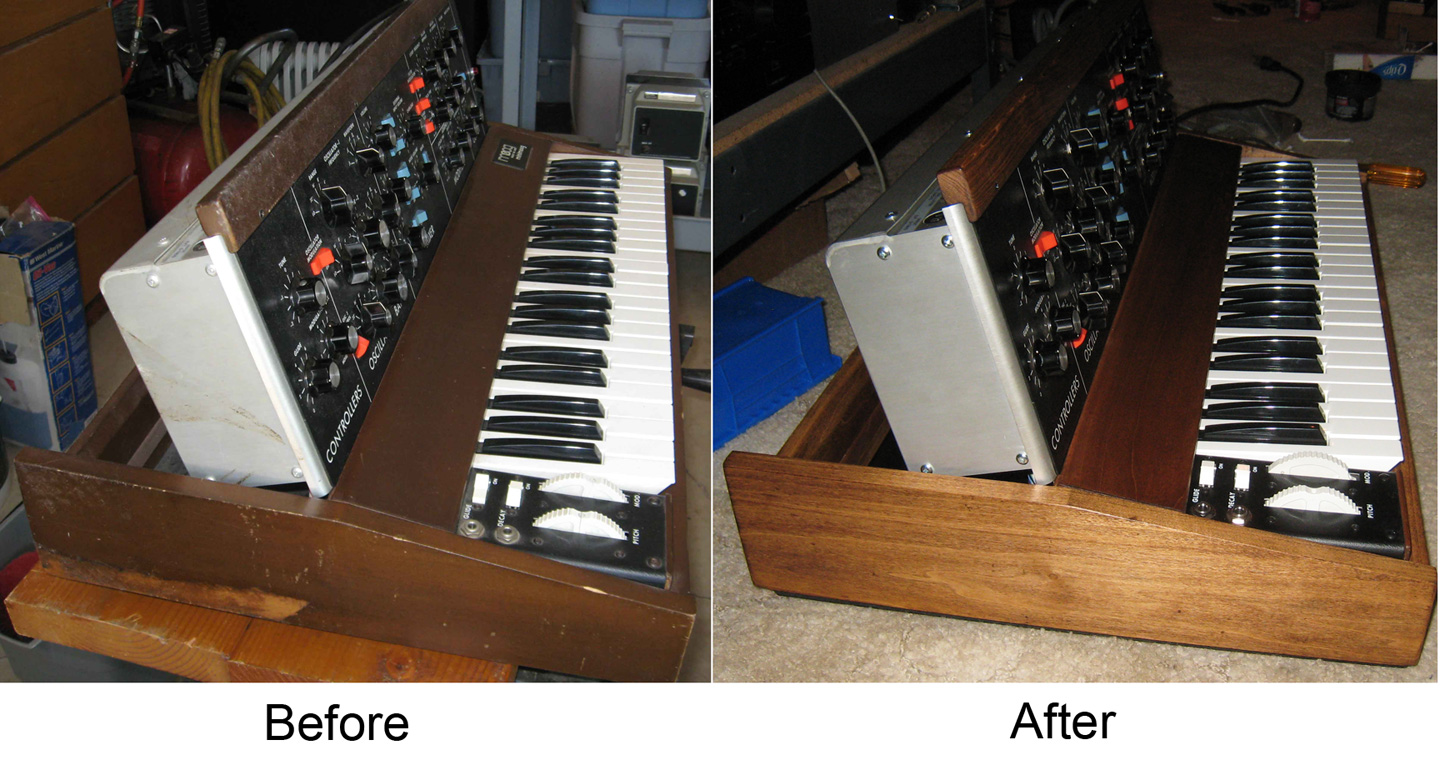
Btw, this particular Mini was bashed from shipping.
The right side where the power cord comes in was very badly dented.
The switch for 115/230 AC was destroyed.
I was able to bend everything back and replace that switch.
One probably couldn’t tell it was ever hit now.
Fwiw, there is one issue I sometimes address that can affect the sound.
Most Minis have envelopes where the attack portion overshoots the sustain level.
This is likely the “bump” of sound that Craig Anderton (and later Synths.com) remarked about being the reason Minis sound punchy.
But I prefer envs to work as stated and designed.
So sometimes I will mod the filter env to be “correct.”
I don’t touch the VCA env usually.
If there IS some punchiness due to this error on the VCA, I don’t remove it.
But filter envs are more obvious.
To check if your Mini D has this issue, set up the filter and env like this:
Long attack, min decay, max sustain.
Turn up the emphasis (resonance) and listen to the “siren.”
(Turn the frequency down enough that it doesn’t go past your range of hearing, of course.)
If the issue is present, the pitch will go up through the attack portion, then fall back to the sustain level.
A normal env would rise until it reached the sustain level and then stay there.
But with this issue, the attack portion rises past the sustain level, then drops down.
It’s very noticeable and can frustrate a player by suggesting their sustain control doesn’t go high enough.
One warning: Once you set it up to check this, it’s often hard to ignore afterward. 
 I guess Cheerios isn’t the only thing multigrain.


