I notice that on my cloned 921a, when I switch from Octave to Semitone using the white rocker switch, the pitch jumps up considerably…maybe 1-2 octaves…I’m not sure if this is correct..maybe I have a fault in there…is this jump normal?
I too have a clone but in my case it’s MOS-LAB, not home built.
IF the semitone/octave switch circuit is not calibrated perfectly, the “0” on the dial will yield a noticeable difference; the range of the 921a is tremendous, something like 12 octaves if the panel graphics are right.
All I know is that it’s well beyond audible on the high side and so slow on the low end (921a FREQ fully CCW and 921b to “LO”) that it’s something like 1 cycle every 90 seconds; and I’m fairly certain I can go even lower.
Is there a trimmer in the circuit for tuning the octave independently from semitones or is it just a scaling?
Thanks for reply EM.
Well I have checked schematics of the 921a and cannot see any way to calibrate octave/semitone for same pitch when the panel rocker is used…maybe I missed something ?
But does your Mos Lab 921a jump pitch between octave/semitone ?
Rarecomponent, I assume that your Frequency knob is at zero (top center) when switching from octave to semitone ?
That’s just the thing, it IS at zero, or so it seems.
I recorded this brief ‘demo’ to show how difficult it is; no intentional fumbling around, it took me nearly a minute to get them to line up perfectly; otherwise, yes. It will jump. https://www.youtube.com/watch?v=n1fvcz7yNgI&list=UUkp9UlX6yFA8sSgkxHY6BiA
I’m not well versed enough in electronics to know how the voltage scaling works in the two different modes except that, obviously there is an expo converter in there somewhere. Note that the MOS-LAB version of the 921a has no less than 3 trimmers. One may be for pulse width center point, one for tuning frequency, one for range? I’ve lost track of which modules are dead straight clones of the Moog modules vs. signal compatible vs. Clones with ‘Improvements’; I know that lots of folks sought to ‘improve’ the 901 and MY particular 921b have an additional gain circuit which juices the Vpp to 5v. As of this past spring, Sebastien has went back to making them identical to the original from an output perspective.
After I recorded the video, I realized that playing different octaves was pointless because, based on my understanding, there is only a base frequency being generated which is subsequently scaled by each 921b.
Hope this helps.

Frequency at zero.
Yes …exact same with my clone as on your demo..I guess this is how they were made.
My reason for posting this is that for some time I’ve noticed that the over all pitch of my modular seems very high when compared to say Arturias Mod V…even accounting for midi base settings . I’ve found the only way to bring the overall pitch down is by using Octave selection on the 921a…and it does need to come down quite a bit.
I’m just going by ear …the semitone selection does not bring it down far enough. What is the switch usually set at ?octave or semitone ?
With an orchestral instrument you know what to expect when playing a certain octave..on the Moogs I haven’t a clue.
I would think that the A440 (A4) would be the reference when tuning any instrument ?
Thanks for the video EMwhite.
So, extremely sensitive Frequency knob depending on the range selected. It seems normal given the extreme octave range (12 octaves !). But it doesn’t explain why Rarecomponent has a big pitch difference at the zero position, unless his module is in need of re-calibration.
BTW, Moog Music’s (the old one) description of the 921a states that the frequency knob lowers frequency control output at the rate of 500 mV for each octave increase in setting. In other words, it’s reversed, the higher you go up in frequency, the lower the control voltage. So it is indeed exponential. And the total range of the output, still according to Moog, is from +9 V to -3 V (-18 to +6 octaves, respectively) going to the 921b module.
(thanks to Moog Archives for the image below)
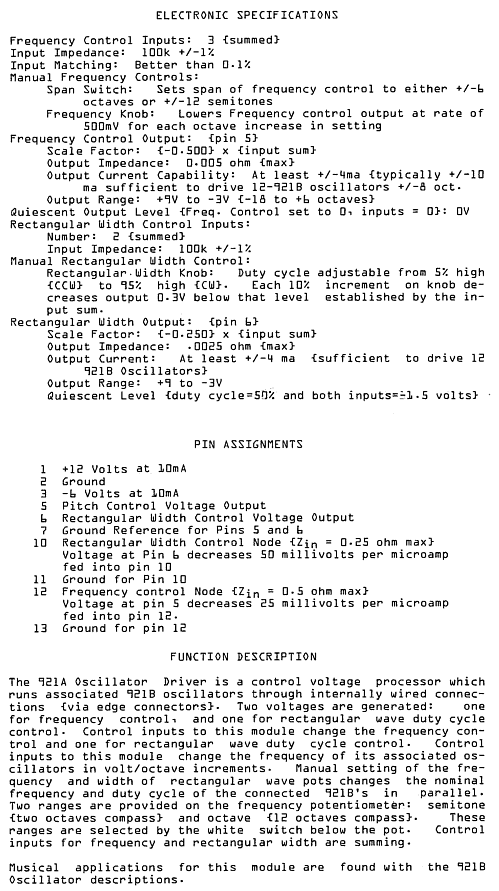
I’ve got another 921a and 921b coming and am fixing to join the 3rd OSC to the 1st driver (that I have already) or to have it split to drive two independent voices.
It should be fairly straight forward especially considering the amount of power the 921a has behind it (spec sheet says it can drive 12 921b’s)
As for tuning; I’ve got a few digital’ish synths such as a Juno 106, an Opus 3, and a Kurzweil that stay in ‘tune’, then I have a Vintage Minimoog whose A440 generator is a tad out; and two SEMs which I’m constantly fiddling with.
I’ll tune my bass to the rest of it but I guess the net net is that if I’m not turning everything on, I tend to have just the Minimoog and the Modular in tune with each other and I keep my switch on Semitones so I can more easily dial it in versus messing with fractions of a degree in the Octave position.
I imagine though that once I get the new OSC, I may end up using it in LFO mode in which case it will go into Octave mode when required.
I think I mentioned above that I’ve got two SEM based Midi->CV converters (5 octave range) and a dotcom keyboard (which lets me bind any midi note to any split point) so it’s pretty flexible. The old Minimoogs I think had 0V at the lowest key which was an ‘F’ of course I don’t think that there was anything that said that 0V = 440Hz. or a common fraction of; I think they were just calibrated such that the upper A and lower A were 3520 and 440 Hz. respectively.
Sorry I should have been clearer with the frequency at O ..then yes there’s no apparent jump in pitch..careful adjustment brings them to sync in tone when flipping the rocker switch.
I think its just an added resister in the Octave \ semitone switch making the big difference.
But it would be great for some definitive Moogy person playing a correctly adjusted modular (with both 921a\b at O frequencies and say 8" )…play a midi a440 and see what pitch it generates. I guess it would make a great reference video.