I have seen quite a few photo’s of Moog systems where the 907 has some thing installed in the centre of the large space between the in/out sockets. Anyone know what this might be…?
A bypass switch perhaps?
Mine doesn’t have it and most of the ones I see out there don’t either. Was this a factory mod…?
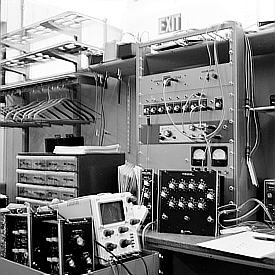
I would have guessed it was a user installed modification. Then I noticed a photo on the Moog Archives site with a 907 on the bench at the Trumansburg factory with that same mod.
I have a panel here, and the hole looks to be punched and not drilled and in the same location as the others. Have seen some with Dymo lables for the bypass switch. Would seem to be a factory mod intended for live performance settings. The 1C they made for the “Jazz in the Garden” concert had the bypass switch. This was later sold to Keith Emerson. Looked like this one with Dymo lables on it.
This is indeed a factory thing for many synths. Th Bypass was installed as the FFBanks are one of the NOISIEST modules, ever. So easy enough to leave it patched and bypass with the switch. The Chris Swansen synth (among others) have this modification. The small DYMO labels are a sign of factory work - they used them quite a bit, as many synths (Emerson, Carlos, etc) had custom features…
There is an early circa-1966 Moog from a University that had each band brought out to a tablet switch (like a Hmmond L100) to allow the user on/off for any band very quickly. GREAT idea with musical uses.
One Moog employee designed a 914 bank to have controls over each band, and the sequencer would turn them on/off in patterns. Another great concept!
Wouldn’t be very hard. You just shunt each output to ground with a transistor, whose base is tied to a sequencer control. Similar concept to the ARP ProSoloist with its preset control.
Sorry - none available, it was MUCH more complex than I described (more options and features, but that’s the basic idea), and required a lot of custom boards built. Yes, it is one of the MuRF inspirations, along with several CV controlled Fixed Filter Banks that Bob Moog built for people in the mid-'70s.
Have some photos of the custom 907 with the organ tabs.
The custom controller. Plenty of Dymo lables on that one!
And a photo of the system with those strange deep disk knobs.
Custom controller on top.
A pic of the rear connections to the 907 where you can see the custom wiring. 11 wires for 10 switches and a green common? (Just might shunt to ground.) Top 3 wires are the power +12/-6/GND.
And a pic of the system recently restored.
Looks like new Dymo lables on that controller?
That system was full of those lables, and looks like every knob had a number designation, including those organ tabs.
I posted this pic in the 901D thread, but this is a photo the same system from back in the day!
EDIT: FWIW my 907 is not noisy at all, quite the opposite. The output is about 70% or so lower in amplitude. Could be noisy ones have been modded to increase the amplitude, or mounted near an EMF source like a power supply. Just like the 905 reverb those coils will pickup stray EMF. (Although toroids are pretty good at keeping unwanted stray signals out.)
I use the 907 all the time to sweeten up the Minimoog and then run it through a 902 VCA to boost the gain and give it a vintage tone. Never noticed noisy?
That system with the organ tabs is from Emerson Myers of Catholic University, one of the very first big system orders Moog ever fulfilled, supposedly late 1967. I’m not sure how much was factory-done, but certainly much of this could have been modifications (even the knobs) easily done by anyone at the University. Although the little Dymo labels are common from Trumansburg, it seems to number EVERY function would be a good way to document patches, and maybe was done by the school or Myers himself.
Here’s a photo of the Chris Swansen system from NMC (formerly Cantos Museum) in Canada. His 907 also had the bypass switch and dymos from the factory. Oops “board attachment quota has been reached!” No pics today… sorry.
My 991 Attenuator, 912 Envelope Follower, and CP1 modules look like early if not prototype models, and there are Dymo labels on all, same size and font as the 907 pic. It must have been a standard practice at the Trumansburg factory. I still have that orange plastic labelmaker somewhere…