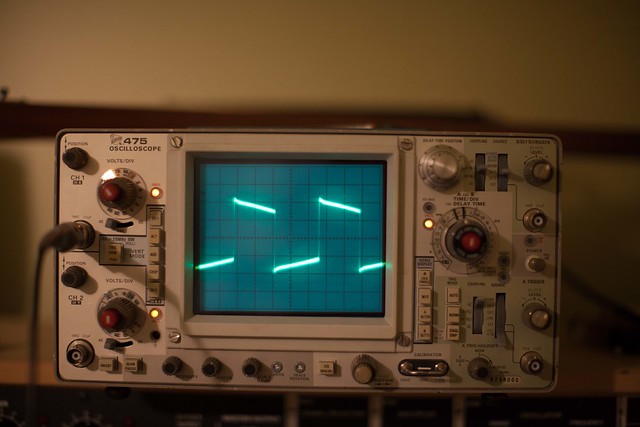
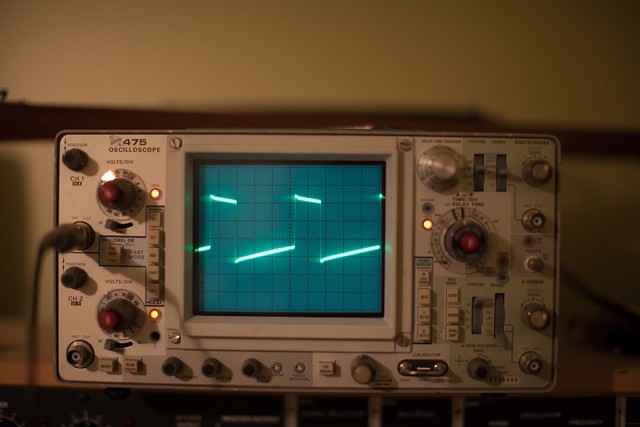
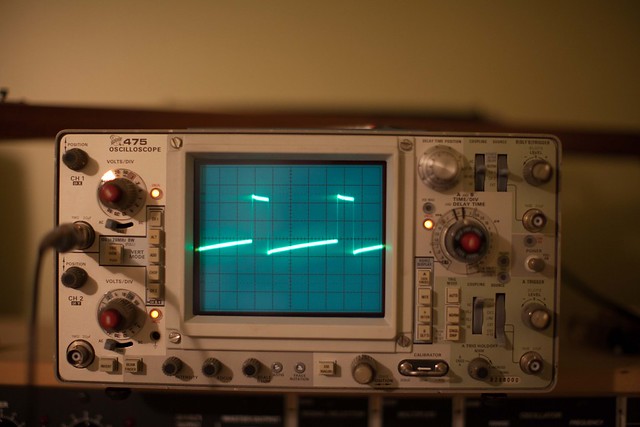
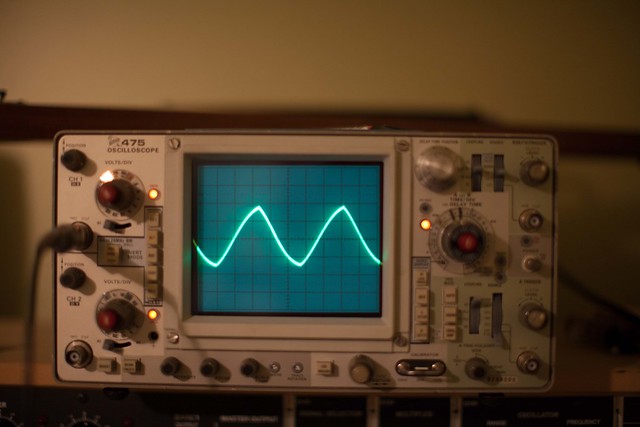
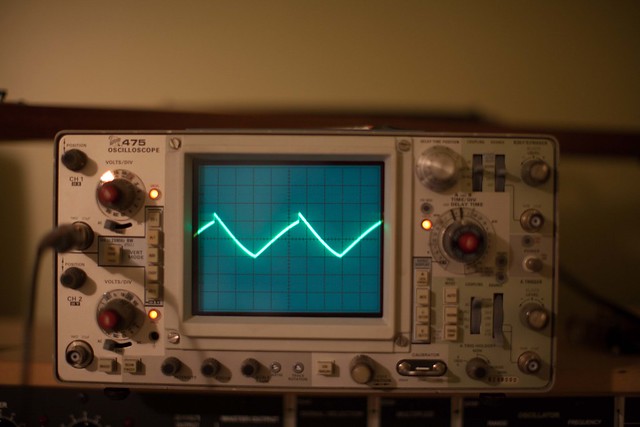
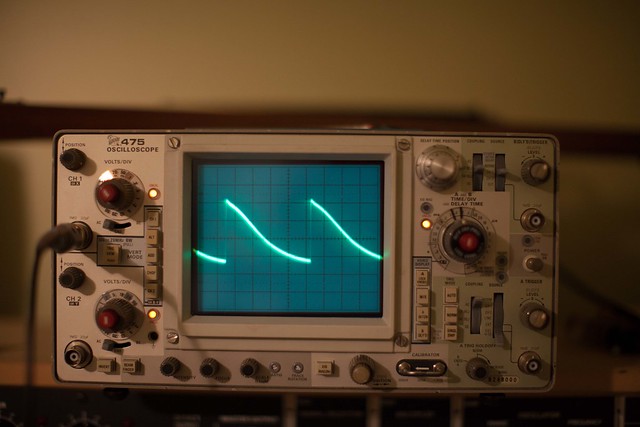
I`ve a Minimoog for a longer time now and observed in the last time a significant difference in sound only with the square waves of oscillator 1 and 2.
The square of the 3. sounds completely clean and strongly hollow (like it should be) and like those of my other synths. But 1 and 2 more like a sawtooth wave and slightly velvetly, but despite hollow but far less than the 3.
Has anybody an idea where I have to spot this in the electronics.
I know, the Instrument is pretty old and rarely used, absolutely no scratching of any other pot, all is working fine, even the wave selectors.
All other waveshapes sound also completely the same.
Ive been already told, if the +/- 10 Volt of the powersupply wouldnt be there correctly ALL 3 oscillators wouldnt work. Also, there are no caps in that circuit area, only resistors, but other caps would eventually ! cause all this, Ive been told.
Anyone familiar with the venerable Minimoog D knows that this is the usual behavior for this classic synth, with all its other classic quirks like: the envelopes short peaks higher then the set sustain level, the saturated filter when mixer levels are set to more than 7, the mod wheel modulation faint bleeding even with the mod wheel at minimum, the different glide speeds for a given time setting depending if it goes up, or down, the slight and slow pitch drift of the oscillators over time, the different pitch bend range of the pitch bend wheel depending on up or down, etc etc…
All part of the Minimoog D charm, and all perfectly normal.
A perfect, precise, digital machine this certainly isn’t. And we can thank Bill Hemsath, Jim Scott, Chad Hunt, and of course Bob Moog (the creative team behind the Minimoog D) for that !
So, stop worrying about it and simply play something on it !!
As nobody else gave a respond it seems true that you hit the point.
But still its very odd to me that a Minimoog has oscillators with Imperfect square waves. There MUST be somehow anything be done to adjust. Its really disappointing to have mostly saw instead of square waves.
I wont let lose before Ill find a way to improve.
But about the rest, the saturation of the Filter I know about, and the Envelope behaviour.
But the rest you mentioned I don`t have on mine.
Oh, how impressive what images sometimes can tell.
I`d wish I could have a machine like that but I cannot afford. They seem to be pretty expensive.
Curious about, if my Mini would show the same or similar.
I only paid about 300 for that oscilloscope, and you can find them much cheaper than that on places like ebay.
http://www.ebay.com/usr/workingman.mv?_trksid=p2057872.m2749.l2754
I purchased mine from this seller, and it was packed well and had been serviced. I think he is in Missouri. He currently doesn’t have anything for sale but a good friend of mine and tech pointed the unit out to me. You can find all types of used and off-brand scopes as low as 20 bucks, with no guarantees of course.
is it possible for someone to briefly explain the connections between the synth and your oscilliscope - do you require a CV Output and ground from your synth or are the connections being made with the cover of the synth being opened?
Rudi,
Thanks for the tip. I bought that scope and had/have absolutely no idea how to use it so I tweaked knobs until I got a reading. I use it for eye candy. I have no EE skills, and no Elmer but love watching the waveforms nonetheless.
Checkmate,
No problem. You still might want to read the manual because prior to Rudi’s post I had no idea that more information would be imparted to the wave depending on the settings. I’m not taking any measurements though and that scope is way more powerful than anything I would ever use it for.
Thanks Eric for the advice, but currently as for the money it looks desasterous to me.
But one important question:
It looks like you picked up the audio signal on the output.
It is more important to see the shapes after having picked up the signal directly on the oscillator board before having been “influenced” by anything coming after ?
Why a disaster?
If you consider that the O-Tool modules can cost $250-400 for a tiny screen and no capacity to do any worthwhile measurements, I’d say it’s a good deal. It’s a nice scope. But you can go to an Amateur Radio swap meet and pick out one or find some on ebay in the $20 dollar range and up if you get lucky. There are computer programs that will do that also, or maybe some used digital scopes out there or a hand-held unit.
Maybe for your purposes (diagnostics) you want to see the exact raw oscillator wave output prior to the mixer, filter, VCA, etc, but I have no business probing around in there.
Hey EricK, I don’t mean to go a little off topic here, but how does one choose a good oscilloscope? I’ve wanted one for a long time, and the analog ones look great. Is the 475 easy to use and maintain?
I clicked on your ebay link but yeah, the guy has nothing up right now. I found this place:
I like that the one you got was really affordable, so if you could offer opinions, that would be great. Also, Rudi recommended that you make some kind of a change, which you subsequently did. Something about DC something or other. Is this hard to do for someone untrained in EE? Would your 475 break or break anything if that change isn’t done?
Someone else would really be better at answering that question than me because I have no EE knowledge.
s far as making the change Rudi mentioned I just flipped the switch.
I’f I’m not mistaken though, 20MHz is all you need for audio frequency monitoring. I like the 2-channel scope so that I can compare waves from different sources.
I haven’t looked at any of these sellers but these are all nice prices. But you can always find off-brand scopes cheap. http://www.ebay.com/bhp/tektronix-475
These analog scopes are huge and heavy though.
Eric
Here’s a list of searches which may help you get all the info you need:
Thanks EricK. That’s a great wealth of information and reading material. The physics of the synths we play are fascinating, eh?
BTW, if you or anyone needs one, I spoke to John, who runs his own ebay store called Teletek. He goes by the username Teletek23. I called him and he taught me a bit about oscilloscopes and made an interesting point, that if we’re interested in the quality of certain waves in a recording environment, running a plugin should be considered, because that’s the what’s being processed in the end.
Hey thx again EricK. I’m going to do my homework now.