The bubble wrap does not seem to create any static electricity issues at all however it is a tempting to pop it from time to time  I always enjoy hearing the variety of solutions this forum offers!
As long as your cloth cover fully covers the synth and doesn’t allow for a lot of air flow, AND isn’t particularly lacking in density, dust isn’t going to get through. Of course, because it’s cloth, dust might come FROM it, but isn’t necessarily getting THROUGH it.
I’ve always thought a plastic like a trashbag, as held down by heavy cloth like a pillow case or towel would work wonderfully, if you were really seeking to keep dust off of your synth.
But let’s face it: the biggest problem isn’t a few stray dust particles, the the biggest problem is putting some sort of cover over your synth and not playing it for a long time. If you have synths that you don’t play frequently, you should probably just keep them in cases… and also prepare for the eventuality of having to twist pots a lot. Synths with knobs need to be played frequently. The older they are, the more unhappy they’ll be if they’re not played. Synths that are played a lot don’t gather dust… because you won’t let them.
Respectfully disagree.
The dust I am seeing is light colored.
The towels I am covering the synths with are black.
The dust is the same material whether the synths were covered or not. It is a very fine dust. Cloth is porous, very fine dust is going to go through it. The light colored dust is not coming from the black towels.
Uh, do you know where the fine dust you’re talking about come from ? Mostly from dead human skin cells. Unless your covered synths are in a sanding workshop ? 
Maybe vacuuming the floors more often would reduce the amount, and it wouldn’t then easily go thru the cloth covers ?


Just kidding MC…

Oh yes my mates, THINK of the statics, some ICs are really prone for it. I.ex. the TOS chips for the Poly.
I also have been recently chastised from my tech NOT to cover the side slids of my CHROMA, even after swapping the PSU into a “almost not heating any more” SPSU. Even this small warmth HAS TO go out…
As for the dust, the dust itself it’s not the issue at the end. The big mess is that dust is hygroscopic and attracks water from the air, …I think I need not to continue…
In the first years I had all my synths covered till the late eighties, but if YOU have a beautiful wife at home, you’ll keep her binded up in a sack most of the time ???
So since then I don’t cover any more and buyed a very mellow and big paint brush and go over from time to time.
Except the T2, all my syths looked wonderful inside after opening after a long time…so why should I care…
Respectful ribbing aside, my studio basement is unfinished and the basement ceiling has fiberglass insulation between the floor joints. This fine dust is the insulation shedding. Very annoying stuff. I rent the place so I am not putting any $$$ into any improvement.
these guys make good covers that keep dust out, and they aren’t too expensive:
Thanks Mr Fett.
happy to help
If you have exposed fiberglass insulation in your studio, you owe your lungs (and health and longevity) a lot. Cover that s*** up, if only with 4 mil plastic!
Stephen
.
I don’t know, MC. I told you not to buy cheap towels. 
Hiya,
I purchased two of these for my Yamaha DX7 and DX21. I will see how I get on from here. Thanks for your help.
Paul

Hi folks,
After making enquiries and taking into account the kind advice offered here on MMF, I have decided to go along with Cover It Audio. Many companies were either not able to meet the (MiniMoog & MultiMoog) dimensions, or else they simply did not reply(!). Price includes shipping from US to UK :-

I will post a photo demo upon receipt in 2015! 
Ta,
Paul
Hi,
My MOOG covers from the US arrived this week 
Best,
Paul


And…

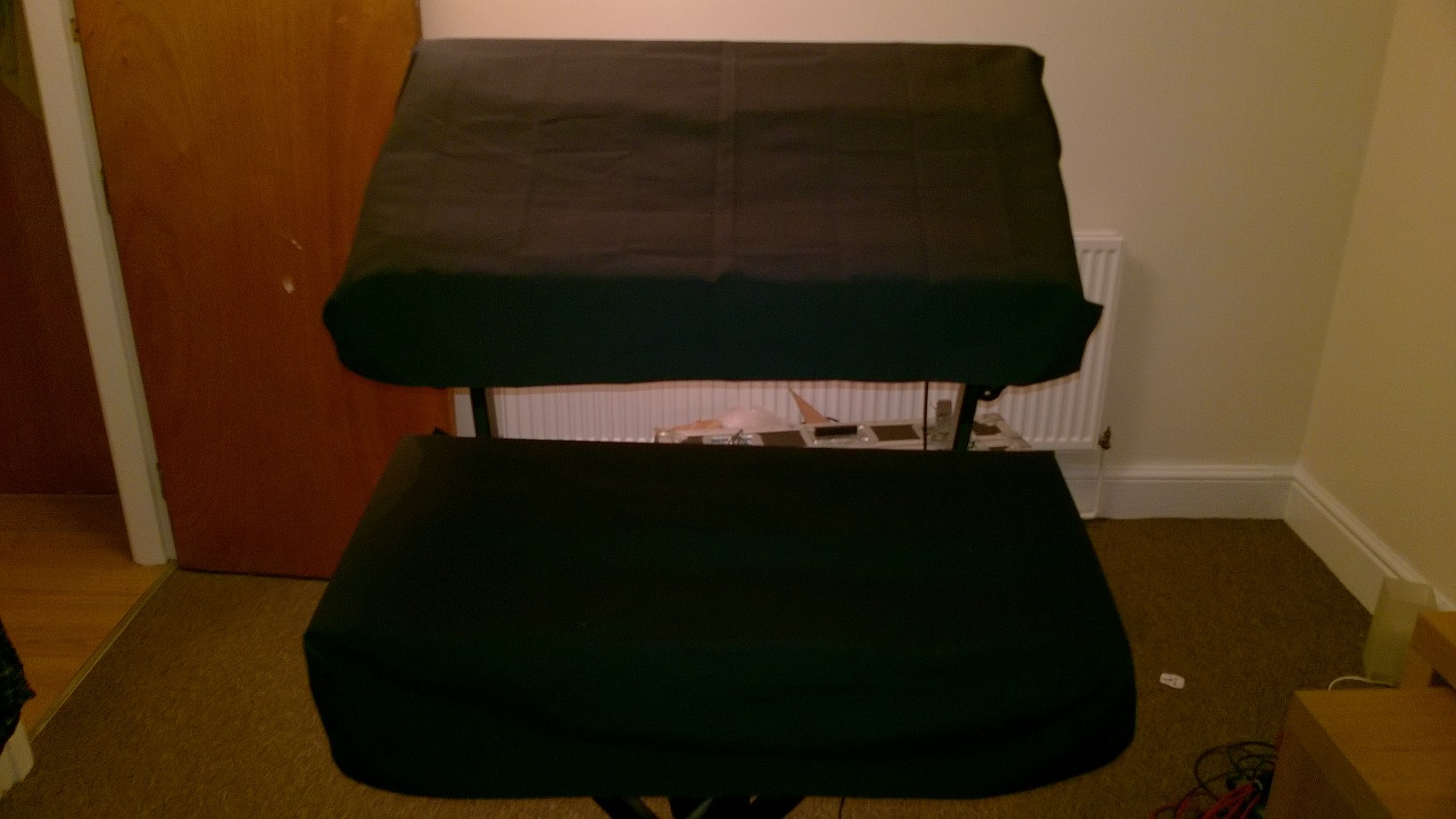
Cover-It-Audio was a good choice. In my opinion, even the simplest of accessories should be researched extensively before buying. Congrats on the covers!
Thanks for the infos, and follow-up photos, Paul !
Hi,
Glad you liked the pic’s!
They may be helpful to anyone else who is thinking of making a similar purchase. Might save them some time hunting around etc.
Cheers,
Paul
Hiya,
Because I have now got my two Moog’s set up (and out of their hard-cases), I wanted to give them regular blasts of electricity and playing. Would it be ok, or not, to leave them powered up but with the dust covers ON? So that they can be left of for a couple of hours at a time (whilst I am not playing them) but with the covers ON (to protect them from dust)?
Obviously “OVERHEATING” is the key word here! 
Thanks,
Paul
A couple of hours you`ll be off ???..Are you living in the Sahara in an open tent ?..
Now seriously, very nice covers, and seem to be very handy for the rehersal room…