more rme’s will cost a lot of extra money for nothing. just think of all the controlling stuff, the knobs etc . useless as one voyager interface could control all of them.
so to keep the costs ( and space ) as low as possible a “one box with voice expansioncards” would be the best solution to mho.
regarding the midi , i guess a good midi-splitter could be neccesary to reduce " latency "
Again: multitracking=free
i play keys/ organ / piano and also preferable synthesizer. so multitracking won’t do for me
Multi tracking, while very cost efficient (if you’ve already got a monosynth) offers limited expression and is rather clunky when one just wants to let the creative juices flow. I’ll often be playing my Phatty and wishing I had just three more voices so I could get nice harmonies going without having to record everything.
Something along the lined of the DSI Tetra would be perfect for me, as I don’t think I could work in something like the Prophet into my budget. However, I know there are those that want polyphony in a stand-alone synth. Perhaps having a few varieties available would be best. There could be the Moog Polysynth 61, and then maybe a less expensive keyboardlesd one, and you could customize it as far as how many voices you wanted and so forth. That way Moog could make their polysynth available to more casual musicians as well as those who want to go all the way.
1968 called, they want Wendy Carlos back
Every time this comes up, I make the same suggestion (already raised in this thread): I’d love to see Moog make the Voyager equivalent of DSI’s PolyEvolver Rack: four voices, minimal front panel, addressable by the Voyager’s panel and/or a computer editor/librarian - period. Based on the actual size of the Voyager’s internal components, how big & deep would this product have to be, reasonably? The idea of multiple RMEs or Slim Phattys in order to achieve polyphony, really seems like a brute force solution; too much rackfill and redundant hardware. It’s better than no option at all, but obviously not a complete or optimal solution.
If Moog were to make a poly, they might as well make a digital synth so long as it sounds good and retains the “Moog sound”. In fact I would prefer if they went digital, because a polyphonic analog synth is not that different from a digital synth. I know, I know, all you purist will disagree, but think about it: It’s one thing to play multitimbral voices, which basically means playing separate synths together, for which a slim phatty rack would make sense, and another thing completely to play a polyphonic, same voice with chords synth, for which high quality digital oscillators through an analog filter/envelope/mod is extremely close, even indistinguishable from a completely analog synth.
The thing is, that you have the analog purists, that don’t want Moog to go digital or build a poly, then you have the so called purists who want a Moog poly but are completely against going digital because “that’s not Moog”, but I would argue that the modern Moog company has only built monophonic analog synths, and that’s what they know best, and their synths are amazing, which I think we can all agree on. I think the company has sacrificed the so called (and completely useless) “purity” of what Moog is all about to make their customers happy, and that is how the slim phatty came about. A slim phatty chain is what everyone has been asking for even if they didn’t know it, a relatively low cost polyphonic solution. But that was not enough, now we want an all in one poly machine that cannot possible be any better than a slim phatty chain soncially, but a new enourmous gaudy keyboard that makes the Voyager look like a DX7. Not going to happen folks, the Voyager is the pinnacle of modern analog synthesis, and I doubt any new synth will be made that rivals it in sound or looks.
The polymoog was a happy mistake. They wanted to make a polyphonic keyboard to gain the edge on the market through technology. They failed miserably, but in doing so created an awesome piece of sht that had mad character. They should remake the polymoog keyboard, a preset divide down organ/synth with minimal tweaking possiblilties on the keyboard itself, but allow for digital editing and preset storage.
i agree fully with most you say,
just imagine playing an 8 voice , affordable, voyager…
you wouldn’t settle for a polyphonic phatty instead ,would you ?
You’ve obviously never owned a Polymoog and a reissue would be a colossal disappointment as well as a huge step backwards.
I don’t see how it would be much of a stretch for Moog to take the guts of 8 Phattys and squish them into a keyboard or 5U rack. Unless they decided to add more features, the daisy-chained Phatty video makes it apparent to me that most of the R & D is already done, so I can’t imagine it’d be too much of a financial risk for the company. And if the price tag is a concern, why not follow in the tradition of the Omega 8 and OBM-x and offer cash-strapped users the option of buying a 2-voice version, with the option of adding voices later? Just some thoughts..
: )
Phatty and Voyager sound very similar, just more features and cooler looks with the Voyager. The Voyager itself and even the phatty offer limitless options when you add in CV and external inputs. As per the polymoog, yes it was a nightmare, but thats why we have technology, to improve shtty designs. The polymoog, specifically the keyboard version was an extremely unique sounding instrument, and that is what any instrument maker regardless of the instrument, should strive for, a tool of expression, not features or cosmetics, though these are important too, the instrument’s value as an instrument is the most crucial factor.
The term “Moog Sound” is thrown around a lot, and it is largely considered to merely be the result of the Moog filter… but when the term was coined, it was a term to describe what distinguished Moog synthesizers (largely the modular) from other synthesizers. It was the tone quality which was the result of the filter, but also the oscillators, and everything else. Because of technological “improvements” in the 1970s, the bundle of aspects which led to the “Moog Sound” were diminished (primarily more “stable” oscillators, which led to a less “organic” sound). Granted, the Moog filter will always give a unique quality to Moog instruments… but “The Moog Sound” is no more. Does playing a Casio through a MF-101 suddenly transform the Casio into a Moog? No, of course it doesn’t.
You take a digital synth and give it a Moog filter and it’ll sound better than it would if it didn’t have a Moog filter, but it’s never going to sound like a Moog, let ALONE possess “The Moog Sound (modern interpretation OR original meaning).”
A polyphonic analog synth, on average, bears absolutely no resemblance to a digital synth… and why would you think it did? I don’t want to point out the obvious here… but polyphonic analog synths (on average) have analog oscillators and an analog filter and an analog LFO (usually), etc. Are you talking about the fact that analog polysynths usually have digital scanning for keys? You know that has no result on the sound quality, right?
The problem about multitimbrality exists because the widening gap between users who play synths with their hands, and users who program synths with sequencers. For the programmer, a chain of synths is fine. For the player, it’s a hassle.
What exactly is a “high quality digital oscillator?”
If you think that digital oscillators are indistinguishable from analog oscillators, that explains how you can be saying any of this.
I guess I’ll be the spokesman for the “analog purists,” since no one else is piping up.
I don’t care what Moog does… they built a guitar, for cryin’ out loud. (and yes, they kicked ass at that) But as far as “going digital,” it is an absolutely ridiculous premise. Moog has cornered the market on analog, and has a VERY long tradition in that market. From a marketing standpoint it would be like them jumping into a market that is absolutely dominated by HUGE corporations with whom they cannot compete. It’s a pointless and unfathomable premise. Why doesn’t McDonalds open a chain of high-end gourmet McDonalds branded restaurants? Why doesn’t Ferrari make a mass-produced economy car? While the creation of a guitar isn’t exactly something within Moog’s market niche, it isn’t the OPPOSITE of its market niche, either.
As for polyphonic synths… if Moog thought they could do it, AND that it wouldn’t sink them, they’d have done it. I’m sure it’s not off the table, but I think we can assume that since they haven’t done it, it isn’t currently a viable option for them. The whole polyphonic conversation comes up simply because people don’t understand that just because they want something, or even 1000 of their friends want something, it doesn’t mean a company can just DO it. I’m sure Moog has done a TON of marketing research and design experiments to see if it’s a good investment for them, and found that currently it isn’t. Being a purist has nothing to do with this. Who would insist that Moog stay monophonic?
Moog has a long-standing tradition of giving the customers what they want… even when what they want is stupid. (“Can you make synthesizers easier to understand, so that we can do really standardized things with them?” -Musician from 1970)
While we in the Analog Purist Division aren’t particularly pleased about the departure from knob-per-function in the Phattys (although the name is a FAR worse offense), Moog undoubtedly went that direction because it made a lower-cost synth feasible… and therefore widened their demographic and marketability. It seems like it has been really successful, and on top of that, they gave people an inexpensive but high-quality Moog product. It’s hard (even as an Analog Purist) to get mad about that.
The Polymoog was a happy mistake? The Polymoog was Moog essentially being among the first synth manufacturers to make a polyphonic synthesizer. It took a huge amount of research, effort, and skill to do it. It was a tremendous risk, but it was not a failure at ALL. It was in production for like 5 years! Everyone wanted a polyphonic synth, and Moog gave it to them- before most anyone else. The only “failing” of the Polymoog was that Moog had to make it very complex to achieve what it did… the “brute force” approach to polyphony. It is a powerful synthesizer with a desirable, distinct, and usable sound.
Many people (especially on the internet) would like to believe that it is an inferior synth because of the divide-down element, but that’s largely because people are horribly ignorant about what can be done with divide-down… and the Polymoog is the best divide-down implementation outside of the Korg PS series.
point is that moog already has a poly-voyager
only problem with it is that it’s very big ( about the size of 1 voyager + 7 rme’s+ one midisplitter ) and very expensive ( something like $17500,- at least )
therefore it would be great and do-able to quit costs by leaving out what’s double/ only use the essential parts ( b.e. 7 full sets of knobs, chassis/ boxes, displays , connections, etc. etc. )
i really wonder what the minimum costs would be the outcome. anything below $5999,- would be a deal and revolution in synthland.
as said the voyager is top of the synth bill, therefore that’s the challenge ( not the phatty with it’s hidden noisegen, although nice synth, maybe a multirack to put some in would be a good idea for that one). the poly-voyager would be an instrument to be proud of and to write history.
hope not to offend anybody with this dream, nor trying to force any company into bankruptcy
wow museslave, I feel honored (not being sarcastic) that someone would take the time to disect something I wrote sin such detail. As far as the digital oscillators, I have heard a couple that were very good, like Native Instruments stuff. But with poly synths, you can’t really detune the oscillators too much and still be able to play stacked chords without muddiness ensuing. I have A/B’d a a few softsynth’s through the MF-102, and when playing chords, it sounds as good if not better than my buddy’s prophet.
You hit the Bulls-------Eye Mr.  Museslave and you are Incredibly entertaining at the same time. Keep up the good work my friend!
There’s always this if it becomes reality. Its only $25000
EDIT: I should mention that the pic is from matrixsynth blog
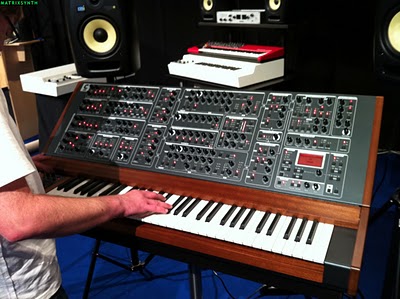
I read it was 25000 Euros, not US dollars. 
For that price, one could get two new Tom Oberheim Son of Four Voice units, and have an 8-voice analog polysynth, and also have enough money left over for a Moog Voyager XL to control the two Oberheims.
that’s really a lot of money for an 8 voice analogpoly

Oh, that’s even worse