I use my Rhodes Suitcase amp. The later models are powerful enough for my needs, the earlier models are good enough for playing at home.
BTW I know a guy who owns a Moog Amp just like that only he also has the 4 large cabinets that it powers. Pretty impressive rig. He’s got a Polymoog as well, but never gigs any of that, especially the Polymoog, because it is so temperamental. Actually I helped him get the Polymoog working when it wouldn’t power up, I opened the lid and there was a loose connection near the power cord inside. Actually maybe he does gig with the Moog Amp, I haven’t seen him play live for a few years now.
I don’t mind the 12" speakers on the Rhodes cab. Maybe I haven’t cranked it up too much. Ironically the Rhodes is what really shakes the Fender speakers when turned up, but I like that. It gives the sound some edge.
I also have an SVT 810 cab if I want to get a bass sound, and a pair of Carvin 15" wedges that have tweeters in 'em. But I rarely if ever use them. I haven’t tried hooking it to the stereo, I’ve got some old JBL L100 3 way speakers and a pair of Norman Laboratories bookshelf speakers, but still I’m pretty good with the Rhodes suitcase amp. Sometimes the Mini will go through either an analog delay (Ibanez AD-230) or a harmonizer (Digitech Super Harmony Machine) and some more preamp gain is introduced through those units.
Ive run Moogs through the Rhodes cabinet, I really felt like the bass was way too much. THe Fender’s Bass pumps out JUST ENOUGH I think to sound excellent through there.
Ive also run my Micro through the KC880 and I felt like the speakers were going to shatter with just a 1 osc sine wave.
I think for synthesizers that have a 20Hz to 20 KHz frequency responce, a PA is better suited to amplify it. Another reasoning behind that is that usually keyboard players have more than a single board.
Whatever you can afford though. The Roland amps are great, in my opinion for the Roland Keyboards, especially with the sub.
I’m not going to pretend I know what would sound the best, I’m just answering the question, that is what I play my minimoog through, my Rhodes. I’m sure it has limitations.
I agree about a PA probably being ideal if the PA has all the frequency range covered with 18" Subwoofers, 15 or 12" Woofers and some midrange drivers and tweeter horns. The range of a synth is very wide and if you want the best sounds you’ll try to get good bass amplification AND good higher end amplification for the filter nuances. That’s why most keyboard amps have a tweeter and a midrange. Still, for smaller rooms a good stereo system would be great, or a proper DJ pair of PA speakers.
I use a Peavey Combo 300 Bass amp and a pair of powered near field monitors for mids and highs for my setup. Works good for me. I’m sure there are better choices, but it’s what I’ve had for a long time.
you should use a tube amp head (more watts = more clean power). If you want to get down in the dirt, consider a 30-50 watt amp. If you never want a smidge of glorious tube drive on those sawtooth waves, go with something been 100-200 watts.
To go with that you’d want a cabinet of either full range speakers or an array of speakers with frequency crossovers. Think of a tower speaker you might have for your home stereo. My speakers have a 1" tweeter, something like a 5" midrange speaker and a 15" sub. Consider a cab with a tweeter, a 10" or 12" and a 15" Probably an additional speaker to make the speaker load something realistic that matches the amp (not many speakers can be combined in 3’s to equal a normal amplifier impedence like 4 or 8 ohms).
And you should get out there and gig your Moog! Pair it with a Rhodes or baby B3 (or big one) and you’ll get calls non-stop, probably from professionals, if your skills match your rig!
unless the amp has a labeled “line out” jack, you shouldn’t ever do that. If you were to try to feed the speaker out to something as if it were a line out, you would could very well be destroying your amplifier, as well as overloading the input device to point of destruction. PC sound cards could easily get fried that way.
Micing up speakers is generally the most natural and effective way to record an amp.
no problem, I just re-read your post and realized that was probably what you were saying. If you have a tube amp and want to add some more delicious, analog warmth, and possibly spring reverb if the amp has that, miking up the amp is great. If you are just using a solid state amp to produce tones exactly as they were meant to be heard (in other words not coloring the sound, for better or worse, but usually tube amps color in good ways) then you might as well just record the thing direct.
For what its worth… I use a Kustom KBA65. Its a 12" with plenty of lows from this ported cabinet. 6 band EQ, celestion speaker, and xlr line out. Not too shabby for $150.00
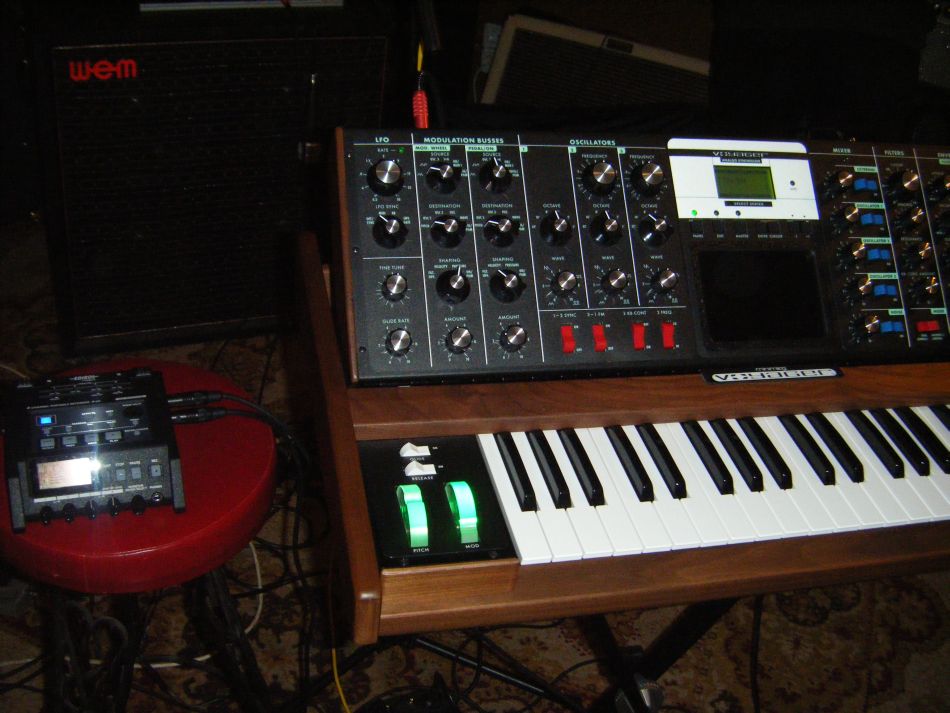
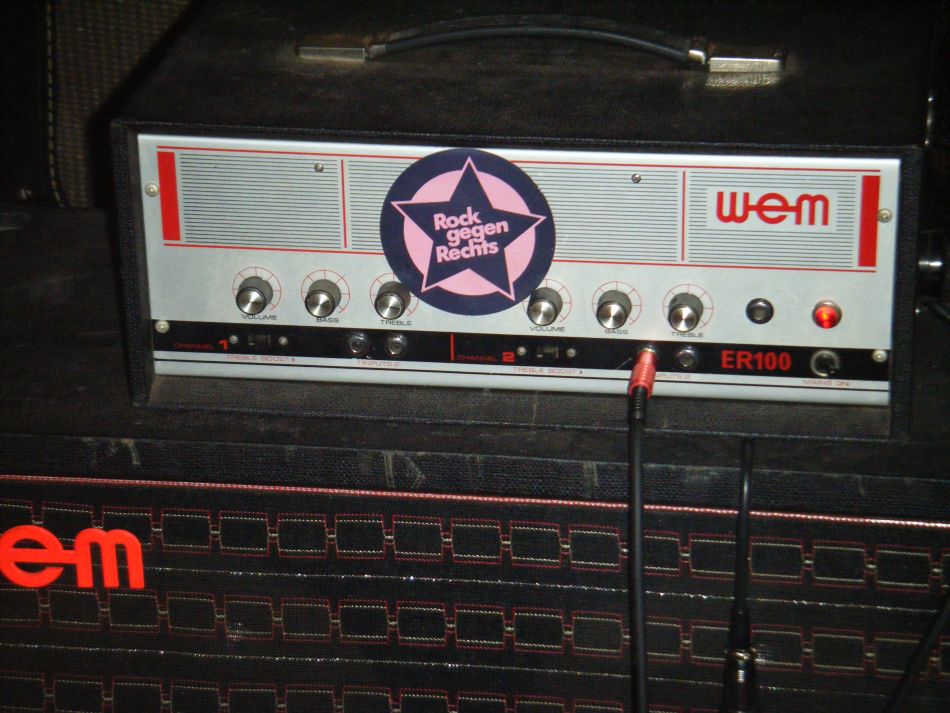
last week we did a session with old friends (Andreas on Guitar and Oskar on Bass) and also very old equipment for amplification. I’ve used an WEM ER100 transistor guitar amp with suitable WEM 100Watts speaker. I was very sceptical in advance whether this combination will give an acceptable result with the Voyager. But I was really surprised about the good appearance. Even with this equipment I was unable to create any bad sound. O.k., the high frequencies on the synthesizer were gone and a kind of an AM sound was achieved but the general result was very dominating and serious.
FOR THE MONEY the Phonic MK-50 can hardly be beat…again, FOR THE MONEY is the key phrase here. Otherwise, get a Peavey KB-3(or used KB/A-60 or KB/A-100) or larger.
Live, I run mine through a vintage Fender Twin, or a Fender Deluxe 1x12 for smaller venues- sounds fabulous! the natural overdrive of the tubes and that great spring reverb helps it sound as meaty and on top as you can get!